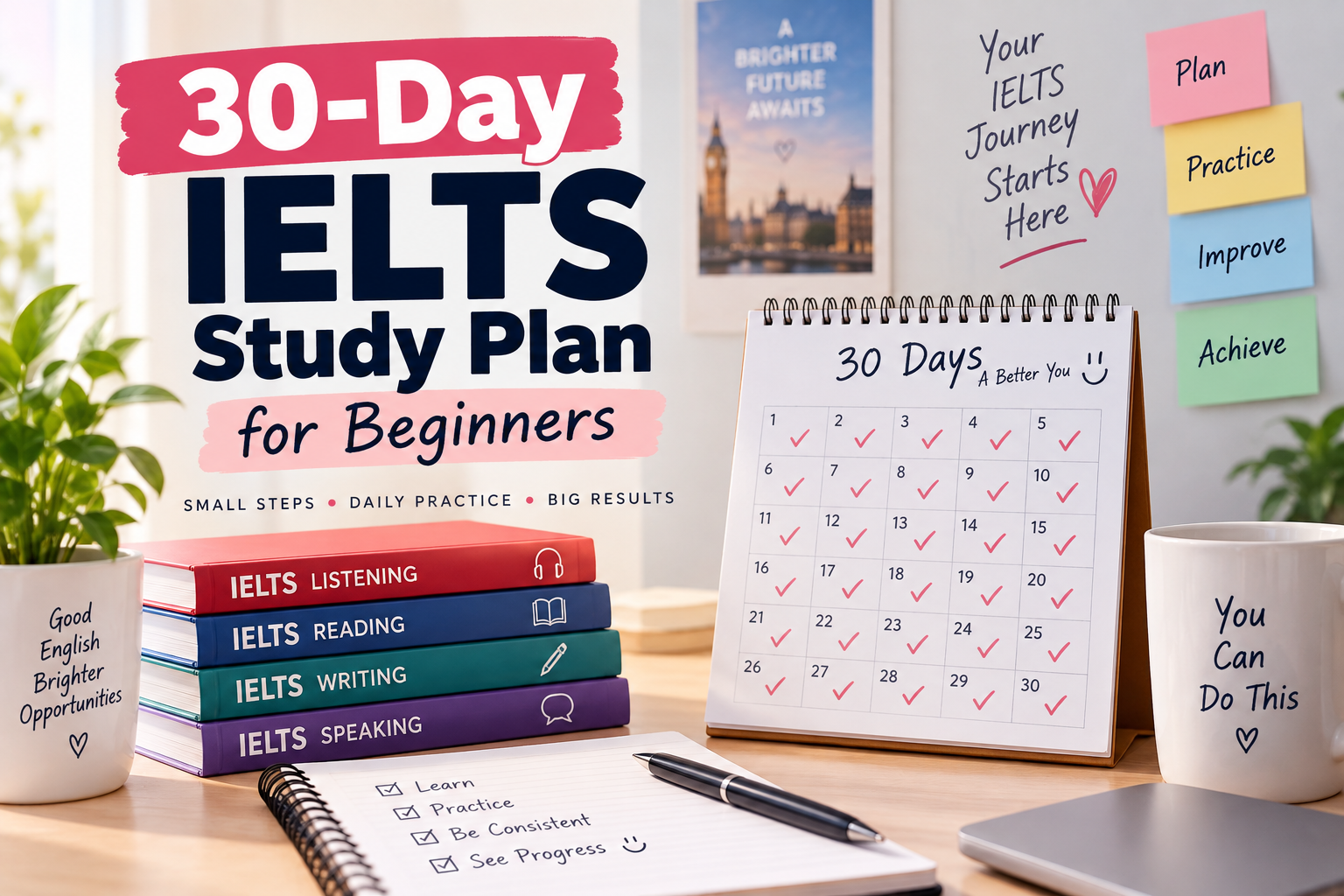
A 30-Day IELTS Study Plan for Beginners

Preparing for IELTS for the first time can feel overwhelming.
You may not know where to begin, which resources to use, how much
vocabulary to learn, how to improve your speaking, or how to manage your time
during the test.
The good news is that you do not need to study everything at once.
With a structured 30-day IELTS study plan, you can
gradually build your English skills, understand the test format, practise each
section and develop the confidence needed for test day.
IELTS assesses four language skills:
●
Listening
●
Reading
●
Writing
●
Speaking
The Listening and Speaking sections are the same in IELTS Academic and
IELTS General Training, while the Reading and Writing sections differ. IELTS
Academic is commonly used for undergraduate or postgraduate study and can also
be required for some professional registration purposes.
This guide provides a beginner-friendly 30-day IELTS preparation
plan that you can adapt according to your current English level and target
band score.
The International English
Language Testing System (IELTS) is an
English-language proficiency test used for study, work, migration and other
international purposes.
Depending on your goal, you may need:
●
IELTS Academic
●
IELTS General Training
●
IELTS for UKVI
●
IELTS Life Skills in specific circumstances
The correct test depends on your destination, institution, visa or
professional requirements. Always check the requirements of the university,
organisation or relevant authority before booking your test.
For students planning to study at undergraduate or postgraduate level,
IELTS Academic is commonly the relevant test.
Before starting your 30-day preparation plan, understand what you are
preparing for.
IELTS has four sections:
|
Section |
Approximate
Duration |
|
Listening |
30 minutes |
|
Reading |
60 minutes |
|
Writing |
60 minutes |
|
Speaking |
11–14 minutes |
The Academic test takes approximately 2 hours and 45 minutes
for the Listening, Reading and Writing components, with Speaking conducted
separately.
Understanding the structure is important because IELTS is not simply
an English knowledge test.
You also need to understand:
●
Question types
●
Timing
●
Instructions
●
Assessment criteria
●
Answer formats
●
Task requirements
●
Strategies for each section
The Listening test has four parts and 40 questions. You hear
the recordings once, and different accents may be used.
You may encounter question types such as:
●
Multiple choice
●
Matching
●
Form completion
●
Note completion
●
Table completion
●
Flow-chart completion
●
Summary completion
●
Sentence completion
●
Short-answer questions
●
Map or diagram labelling
A key skill is learning to predict what information you need before
the recording moves on.
Academic Reading lasts 60 minutes and contains three reading
passages with different question types. These can include:
●
Multiple choice
●
True/False/Not Given
●
Yes/No/Not Given
●
Matching headings
●
Matching information
●
Sentence completion
●
Summary completion
●
Short-answer questions
The official IELTS sample materials recommend using practice tasks to
become familiar with question types and completing exercises under timed
conditions.
IELTS Writing lasts 60 minutes and contains two tasks.
For Academic Writing:
You may need to describe, summarise or explain information presented
in a:
●
Graph
●
Chart
●
Table
●
Diagram
●
Process
You need to write at least 150 words.
You write an essay responding to a point of view, argument or problem.
You need to write at least 250 words.
Task 2 contributes twice as much as Task 1 to the Writing score, so
your preparation should reflect this.
Writing is assessed using criteria including:
●
Task achievement/response
●
Coherence and cohesion
●
Lexical resource
●
Grammatical range and accuracy
The Speaking test lasts approximately 11–14 minutes and
consists of three parts.
General questions about familiar topics such as:
●
Home
●
Family
●
Work
●
Studies
●
Interests
●
Daily life
You receive a topic card, have one minute to prepare, and then
speak for up to two minutes.
You discuss broader and more abstract questions related to the Part 2
topic.
Speaking is assessed on:
●
Fluency and coherence
●
Lexical resource
●
Grammatical range and accuracy
●
Pronunciation
Before starting, remember that this is a general beginner plan.
Your ideal schedule depends on:
●
Current English level
●
Target band score
●
Previous IELTS experience
●
Available study time
●
Test type
●
Exam date
●
Strong and weak skills
For this plan, aim for approximately:
2–3 hours per day
If you have less time, divide the activities across your available
hours rather than skipping a section completely.
Your first day should focus on understanding the examination rather
than immediately completing difficult practice tests.
●
Confirm whether you need Academic or General
Training.
●
Learn the structure of all four sections.
●
Understand the timing.
●
Review the question types.
●
Take a short diagnostic test.
Identify your current level.
Create four scores:
Listening: ___
Reading: ___
Writing: ___
Speaking: ___
Do not worry if your first scores are low.
The purpose of the diagnostic test is to discover where you need
improvement.
Vocabulary affects all four IELTS skills.
However, don't try to memorise hundreds of random words.
Instead, learn vocabulary by topic.
Start with:
●
Education
●
Technology
●
Environment
●
Health
●
Work
●
Travel
●
Society
●
Family
●
Communication
For every new word, record:
Word → Meaning → Example sentence → Synonym
For example:
Significant
Meaning: Important or considerable.
Example:
“Technology has had a significant impact on education.”
Synonym:
“Important”
Learn approximately 10–15 useful words and, more importantly,
practise using them.
Today, focus on understanding spoken English.
Listen to English conversations, interviews or educational content.
Focus on:
●
Names
●
Numbers
●
Dates
●
Times
●
Places
●
Spelling
●
Changes of information
●
Signposting language
Then complete a short IELTS Listening practice set.
Don't become frustrated when you miss one answer.
The recording continues.
Train yourself to move forward instead of losing several answers
because you were thinking about one missed question.
Start learning how to read strategically.
Do not try to understand every single word in an IELTS passage.
Practise:
Read quickly to understand the general idea.
Search for specific information.
Identify important words in the question.
Learn to recognise when the passage expresses an idea using different
words.
For example:
Question: The number of students increased
significantly.
Passage: Student enrolment rose considerably.
The words are different, but the meaning is similar.
Today, focus on sentence construction and paragraph structure.
Practise writing:
●
Simple sentences
●
Compound sentences
●
Complex sentences
●
Topic sentences
●
Supporting ideas
●
Examples
●
Conclusions
A basic paragraph structure can be:
Main idea → Explanation → Example → Result/Link
Avoid trying to use complicated vocabulary if you cannot use it
accurately.
Clear and accurate English is more useful than unnecessarily
complicated English.
Start speaking English aloud.
Do not practise only inside your head.
Choose common topics:
●
Your hometown
●
Your family
●
Your studies
●
Your work
●
Your hobbies
●
Your future plans
●
Your favourite place
●
Travel
Record yourself answering questions for 1–2 minutes.
Then listen to the recording.
Look for:
●
Long pauses
●
Repeated words
●
Grammar mistakes
●
Pronunciation problems
●
Very short answers
Today is your first review day.
Complete:
●
One Listening practice
●
One Reading practice
●
One Writing task
●
10–15 minutes of Speaking practice
Then review your mistakes.
Create four lists:
This becomes your personal IELTS improvement tracker.
The second week focuses on improving accuracy and understanding IELTS
question types.
Practise:
●
Form completion
●
Note completion
●
Sentence completion
●
Multiple choice
Before listening, predict:
What type of answer am I expecting?
For example:
●
A number?
●
A name?
●
A place?
●
A noun?
●
A date?
This can make listening more focused.
Focus on:
●
True/False/Not Given
●
Yes/No/Not Given
●
Matching headings
●
Multiple choice
Spend time understanding why an answer is correct.
Don't simply check the answer key.
Find the evidence in the passage.
If you are preparing for IELTS Academic, practise Task 1.
Learn to identify:
●
Main trends
●
Major comparisons
●
Significant changes
●
Highest/lowest figures
●
Similarities
●
Differences
A strong Task 1 response should not simply list every number.
You need to identify the most important information and present it
clearly.
The official IELTS guidance states that Academic Task 1 requires at
least 150 words and assesses your ability to organise and present visual
information appropriately.
Today, focus on essay structure.
A simple structure is:
●
Introduce the topic
●
Present your position or main response
●
Main idea
●
Explanation
●
Example
●
Main idea
●
Explanation
●
Example
●
Summarise your main position
Practise one essay without worrying too much about speed.
Focus on:
Answering the question + organising ideas + accurate language.
Practise common Part 1 topics.
For each question:
For example:
Question: Do you enjoy reading?
Instead of:
“Yes, I do.”
Try:
“Yes, I enjoy reading, especially non-fiction books because they help
me learn about new subjects. I usually read for about 20 minutes before going
to bed.”
The second answer provides more language and information.
Practise the two-minute long turn.
Use the one-minute preparation time effectively.
Write only keywords.
For example:
Topic: Describe a memorable journey.
Notes:
●
Kerala → London
●
First international trip
●
Nervous
●
Met new people
●
Learned independence
●
Would repeat
Then speak naturally using those points.
Don't try to memorise a complete answer.
Complete:
●
One Listening test
●
One Reading test
●
One Writing Task 1
●
One Writing Task 2
●
One Speaking Part 2 recording
Then compare your performance with the previous week.
Ask:
What improved?
What remains weak?
Which section needs the most attention during Week 3?
By Week 3, you should start moving from learning to performance.
Complete a full Listening practice test.
Focus on:
●
Predicting answers
●
Following the recording
●
Spelling
●
Singular/plural forms
●
Numbers
●
Word limits
The official IELTS Listening guidance notes that answers must follow
the stated word limit; exceeding it can result in losing the mark.
After the test, review every incorrect answer.
Complete a full Reading test under timed conditions.
Practise allocating your time strategically.
Do not spend too long on one difficult question.
If a question is taking too long:
Your goal is to complete the entire section.
Set approximately:
20 minutes
for Academic Writing Task 1.
Before writing:
Analyse the visual.
Plan your structure.
Write.
Check:
●
Grammar
●
Spelling
●
Verb tense
●
Comparisons
●
Numbers
●
Articles
The official IELTS guidance recommends spending no more than 20
minutes on Academic Task 1.
Set approximately:
40 minutes
for Task 2.
Use:
Planning
Writing
Checking
Task 2 contributes twice as much as Task 1 to the Writing score,
making it particularly important to practise effectively.
Today's goal is to reduce hesitation.
Choose 10 common IELTS topics.
Speak for:
1–2 minutes per topic
If you don't know a word, don't stop.
Paraphrase.
For example:
Instead of:
“I don't know the word.”
Try describing the idea using other words.
This is useful because IELTS Speaking assesses your ability to
communicate meaning effectively, including your vocabulary range and ability to
express yourself.
Review the grammar errors you repeatedly make.
Focus on:
●
Subject–verb agreement
●
Articles
●
Tenses
●
Prepositions
●
Singular/plural nouns
●
Sentence structure
●
Conditionals
●
Comparatives
●
Complex sentences
Don't try to study every grammar rule in English.
Focus on the mistakes that repeatedly appear in your own writing
and speaking.
Complete a realistic mock test.
Simulate the test environment as closely as possible.
Avoid:
●
Checking your phone
●
Taking unnecessary breaks
●
Using a dictionary
●
Looking at answers during the test
After finishing, calculate your performance and identify your weakest
areas.
The final week focuses on consolidation rather than trying to learn
everything from scratch.
Look at your mock-test results.
Which section is weakest?
Complete additional listening exercises.
Practise question types and timing.
Focus on structure, grammar and task response.
Record yourself and practise with another person.
Spend more time on your weakest skill.
Do not attempt to memorise 500 new words.
Instead, revise the vocabulary you have already learned.
Group words by topic:
●
Curriculum
●
Qualification
●
Institution
●
Academic
●
Scholarship
●
Pollution
●
Sustainability
●
Conservation
●
Renewable
●
Ecosystem
●
Innovation
●
Automation
●
Digitalisation
●
Artificial intelligence
●
Cybersecurity
Practise putting these words into sentences.
Day 24 – Listening and
Reading Mock
Complete:
Full Listening test + Full Reading test
Then spend extra time reviewing your mistakes.
Your review should answer:
Why did I choose the wrong answer?
Possible reasons:
●
I misunderstood the question.
●
I missed the keyword.
●
I couldn't recognise the paraphrase.
●
I ran out of time.
●
I made a spelling mistake.
●
I guessed incorrectly.
Understanding the reason helps prevent the same mistake.
Complete:
Task 1 + Task 2
Use the official time limits.
Then check:
Did I answer the question fully?
Are my ideas logically organised?
Did I use appropriate vocabulary?
Are my sentences accurate?
These areas correspond to the official Writing assessment criteria.
Conduct a complete Speaking simulation.
4–5 minutes
1 minute preparation + up to 2 minutes speaking
4–5 minutes
The official IELTS Speaking format follows these three parts and lasts
approximately 11–14 minutes.
Record yourself if possible.
Then evaluate:
●
Fluency
●
Vocabulary
●
Grammar
●
Pronunciation
●
Answer development
●
Confidence
Today, complete another full mock test.
Compare your results with Day 21.
Ask:
Has my score improved?
Which mistakes are still repeating?
Am I completing each section within the required time?
Which area needs final revision?
Today should be personalised.
If your biggest problem is:
Review topic vocabulary.
Correct recurring grammar errors.
Practise difficult question types.
Practise skimming, scanning and paraphrase recognition.
Rewrite weak paragraphs.
Practise answering questions aloud.
Don't spend your final days studying topics you already understand
well.
Today is not the day for an intense study marathon.
Review:
●
IELTS format
●
Timing
●
Common question types
●
Vocabulary
●
Grammar mistakes
●
Writing structures
●
Speaking strategies
●
Listening techniques
●
Reading strategies
Prepare everything you need for test day.
Most importantly:
Sleep properly.
A tired mind can affect concentration, reading speed, listening
accuracy and speaking fluency.
Keep your study session light.
Review your notes.
Do a short Speaking practice.
Listen to some English.
Review useful vocabulary.
Avoid taking a full mock test if it will increase your anxiety
immediately before the exam.
Your goal today is:
Confidence + Familiarity + Calmness
You have spent the last 30 days building your skills.
Trust your preparation.
|
Day |
Main Focus |
|
1 |
Understand IELTS + Diagnostic Test |
|
2 |
Vocabulary |
|
3 |
Listening Fundamentals |
|
4 |
Reading Fundamentals |
|
5 |
Writing Fundamentals |
|
6 |
Speaking Fundamentals |
|
7 |
Weekly Review |
|
8 |
Listening Question Types |
|
9 |
Reading Question Types |
|
10 |
Writing Task 1 |
|
11 |
Writing Task 2 |
|
12 |
Speaking Part 1 |
|
13 |
Speaking Part 2 |
|
14 |
Week 2 Mock |
|
15 |
Listening Timed Practice |
|
16 |
Reading Time Management |
|
17 |
Writing Task 1 Timed |
|
18 |
Writing Task 2 Timed |
|
19 |
Speaking Fluency |
|
20 |
Grammar |
|
21 |
Full Mock Test |
|
22 |
Weakest Skill |
|
23 |
Vocabulary Review |
|
24 |
Listening + Reading Mock |
|
25 |
Writing Mock |
|
26 |
Speaking Mock |
|
27 |
Full Mock Test |
|
28 |
Weakness Correction |
|
29 |
Light Review |
|
30 |
Final Preparation |
There is no universal number of hours that guarantees a particular
band score.
Your ideal study time depends on your starting level and target.
For beginners, a practical schedule could be:
Vocabulary + grammar
Listening
Reading
Writing or Speaking
Review mistakes
This gives you approximately 2–2.5 hours of focused preparation.
If you only have one hour per day, prioritise your weakest skill and
rotate the other sections.
Vocabulary development should be based on use, not just
memorisation.
Instead of learning:
“Mitigate = reduce”
Create a sentence:
“Governments can introduce policies to mitigate the effects of air
pollution.”
Then create another:
“Better public transport could help mitigate traffic congestion.”
This helps you understand how the word works in context.
Word + Meaning + Collocation + Example + Synonym
For example:
Significant
●
Meaning: Important or considerable
●
Collocation: significant increase
●
Example: There has been a significant increase
in online learning.
●
Synonym: considerable
Follow these habits:
Use interviews, podcasts, educational videos and other
English-language content.
IELTS Listening may include different English accents.
Before the recording, consider what information you need.
A correctly understood answer can still be lost if it is entered
incorrectly.
If you miss one answer, move on.
Don't lose the next three questions while thinking about the first
one.
Read:
●
News articles
●
Academic articles
●
Magazines
●
Reports
●
Opinion pieces
IELTS questions and passages may express the same idea using different
words.
Learn to skim for general meaning and scan for specific information.
Become familiar with:
●
True/False/Not Given
●
Matching headings
●
Multiple choice
●
Sentence completion
●
Summary completion
A common beginner mistake is focusing only on vocabulary.
Good IELTS writing also requires:
●
Relevant ideas
●
Clear organisation
●
Appropriate vocabulary
●
Accurate grammar
●
Logical development
●
Good task response
Before writing, ask:
What exactly is the question asking me to do?
Then plan your response.
For Task 2, avoid writing a memorised essay that does not directly
answer the question.
The official IELTS guidance emphasises relevance, organisation,
vocabulary and grammatical accuracy as key parts of Writing assessment.
You don't need to sound like a native English speaker.
You need to communicate clearly and effectively.
Practise:
Speak without excessive hesitation.
Use a suitable range of words.
Use different sentence structures accurately.
Make your speech understandable.
These are the four official Speaking assessment criteria.
Speak English every day.
Even 15–20 minutes of daily speaking practice can help you become more
comfortable expressing your ideas.
Random practice can make preparation inefficient.
Memorised answers may not properly address the question.
Using unfamiliar words incorrectly can hurt clarity.
Speaking requires regular active practice.
Reading model essays alone does not improve your writing.
Time management is an important part of IELTS preparation.
Practice without analysis provides limited improvement.
Your overall result depends on your performance across the test.
Language improvement takes consistent practice.
Use official IELTS resources to understand the current test format and
practice materials. IELTS provides official sample tasks for both Academic and
General Training candidates.
Yes.
A diagnostic test at the beginning helps you understand your starting
point.
Mock tests during preparation help you measure progress.
A final mock test helps you assess your readiness.
However, don't focus only on the score.
Ask:
Why did I lose marks?
That question is much more valuable.
You may be approaching readiness when you can:
●
Complete Listening practice within the time
limit
●
Complete Reading without leaving large
sections unanswered
●
Write structured responses within the required
time
●
Speak continuously without excessive
hesitation
●
Understand common IELTS question types
●
Recognise your common grammar mistakes
●
Manage your time effectively
●
Explain why you got practice questions wrong
●
Maintain performance across multiple mock
tests
Your readiness should be based on consistent performance, not
one unusually good practice score.
Don't panic.
You can compress the plan.
If you have only two weeks:
Focus on:
●
IELTS format
●
Diagnostic test
●
Listening
●
Reading
●
Writing
●
Speaking
●
Vocabulary
●
Grammar
Focus on:
●
Timed practice
●
Full mock tests
●
Weak areas
●
Writing correction
●
Speaking practice
●
Final revision
If your target score is demanding or your current English level is
significantly below your target, you may need more than 30 days.
The 30-day plan should be viewed as a structured starting framework,
not a guaranteed timeline for achieving a particular band score.
If you want a routine you can follow every day, use:
30 minutes – Listening
30 minutes – Reading
30 minutes – Writing
20 minutes – Speaking
20 minutes – Vocabulary & Grammar
10 minutes – Mistake Review
Total:
2 hours 20 minutes
You can adjust the time based on your schedule.
The most important factor is consistency.
Before your test, make sure you can say:
☑ I understand the IELTS test format.
☑ I know whether I need Academic or General Training.
☑ I have completed diagnostic and mock tests.
☑ I understand my strongest and weakest skills.
☑ I have practised Listening question types.
☑ I have practised Reading under timed conditions.
☑ I can structure my Writing responses.
☑ I practise Speaking aloud.
☑ I review my mistakes.
☑ I understand IELTS Writing and Speaking assessment criteria.
☑ I know how to manage my time.
☑ I have checked the latest official IELTS information.
Preparing for IELTS as a
beginner can seem difficult when you look at the entire examination at once.
Instead, break your preparation into smaller daily goals.
Over 30 days, focus on:
Understand → Practise → Review → Improve → Repeat.
Start by understanding the test.
Then build your vocabulary and grammar.
Next, develop Listening, Reading, Writing and Speaking skills.
Finally, introduce timed practice and full mock tests.
Remember that IELTS preparation is not about memorising hundreds of
answers. It is about developing the ability to understand English, communicate
ideas clearly and respond effectively to the tasks in the examination.
If you are planning to study in the UK or another English-speaking
destination, choosing the right IELTS test and understanding the
English-language requirements for your chosen institution should be your first
step.
For students planning their international education journey, ONT Global can help
you understand your study-abroad options, university admission process and
preparation requirements.
Start with a plan. Study consistently. Practise every day. Take your
next step towards studying abroad with confidence.