OSCE Preparation Guide for International Nurses: Everything You Need to Know


Preparing for the Objective Structured Clinical Examination (OSCE) can feel challenging, especially for international nurses who are adapting to UK nursing standards, clinical communication styles, and professional expectations. However, with the right preparation strategy, regular practice, and a clear understanding of the exam structure, you can approach your OSCE with greater confidence.
This guide covers the essential areas international nurses should focus on, from understanding the exam format to practising clinical skills, communication, documentation, and time management.
OSCE Preparation Guide for International Nurses: Everything You Need to Know
Introduction
Preparing for the Objective Structured Clinical Examination (OSCE) is an important step for many international nurses seeking registration and employment in the UK. The OSCE assesses whether candidates can safely apply their nursing knowledge, clinical skills, communication abilities, professional values and decision-making in realistic clinical scenarios.
For international nurses, OSCE preparation can feel challenging because the examination is based on UK nursing standards and contemporary clinical practice. Success is not simply about memorising steps. Candidates need to understand the rationale behind their actions, communicate effectively with patients and demonstrate safe, person-centred care.
The NMC's current Test of Competence OSCE for nurses consists of 10 stations, including four linked APIE stations, four skills stations, and two stations covering professional values and evidence-based practice. This complete guide explains everything international nurses need to know to prepare effectively.
What Is the OSCE?
The OSCE is the practical component of the NMC Test of Competence. It assesses whether you can apply your professional knowledge and nursing skills in simulated clinical situations.
Unlike a written examination, the OSCE requires you to demonstrate what you would actually do when caring for a patient.
You may be assessed on areas such as:
● Clinical assessment
● Patient communication
● Care planning
● Clinical procedures
● Documentation
● Professional behaviour
● Patient safety
● Evidence-based decision-making
● Infection prevention and control
● Escalation of concerns
The NMC explains that the OSCE is designed to assess clinical and communication skills at the level expected of a nurse entering the UK register. Candidates are expected to apply knowledge rather than simply recall or recite information.
Understanding the OSCE Structure
The nursing OSCE currently contains 10 stations.
1. APIE Stations
Four stations are linked around a patient scenario:
A – Assessment
You will be required to assess the patient and identify relevant information.
This may involve:
● Reviewing patient information
● Taking observations
● Identifying symptoms
● Recognising abnormal findings
● Identifying risks
● Communicating appropriately
The key is to assess the patient systematically and recognise when further action is required.
P – Planning
In the planning station, you may need to use the information gathered during assessment to develop an appropriate plan of care.
Your plan should be:
● Patient-centred
● Safe
● Evidence-based
● Relevant to the patient's needs
● Clearly prioritised
You should demonstrate an understanding of immediate concerns as well as ongoing care needs.
I – Implementation
This station focuses on putting your nursing plan into action.
Depending on the scenario, you may need to:
● Communicate with the patient
● Explain procedures
● Provide appropriate nursing interventions
● Maintain dignity and privacy
● Follow infection prevention procedures
● Monitor the patient's condition
● Escalate concerns when necessary
Always think about patient safety before performing any intervention.
E – Evaluation
The evaluation station assesses your ability to review the effectiveness of care.
You may need to consider:
● Has the patient's condition improved?
● Have the interventions been effective?
● Are further interventions required?
● Does the patient need escalation?
● What should be documented?
● What should be communicated to other healthcare professionals?
The four APIE stations are linked to the same scenario, so information from one stage should help you approach the next stage logically.
2. Clinical Skills Stations
The OSCE also includes four stations that assess clinical skills, arranged as two pairs of skills. The exact scenarios and skills can change as the NMC regularly reviews and updates test content to reflect contemporary clinical practice.
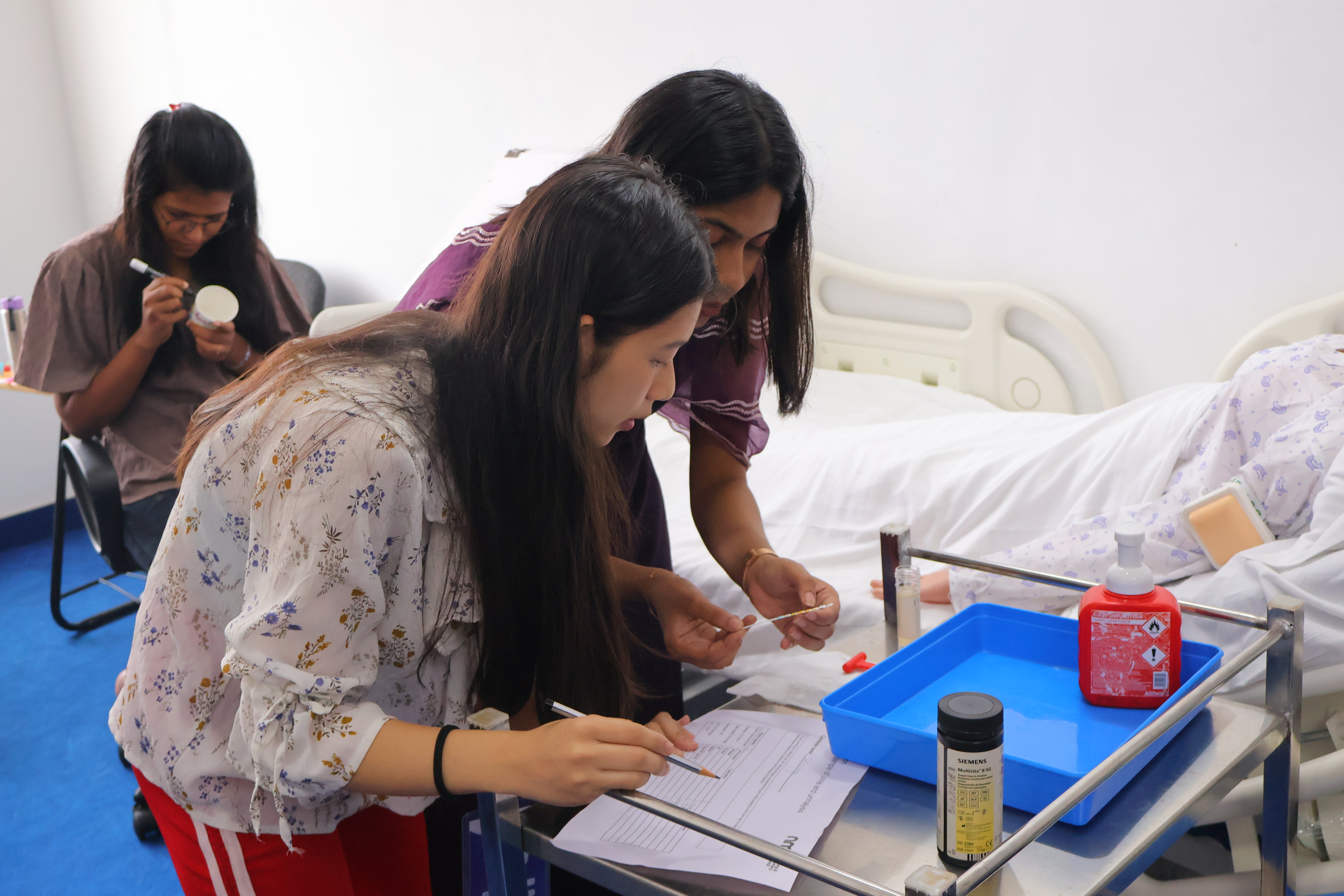
Depending on your field of nursing and the current OSCE materials, preparation may involve practising skills such as:
● Aseptic technique
● Medication-related procedures
● Catheter care
● Wound care
● Vital signs
● Fluid balance
● Blood glucose monitoring
● Patient assessment procedures
● Infection prevention and control
Do not rely only on previously memorised station scripts. The NMC specifically encourages candidates to understand the standards, code and blueprint because scenarios and skills may be refreshed.
3. Professional Values Station
Professional values are a fundamental part of nursing practice.
In this station, you may be assessed on how you respond to situations involving:
● Patient dignity
● Confidentiality
● Consent
● Safeguarding
● Professional boundaries
● Equality and diversity
● Duty of candour
● Raising concerns
● Patient safety
Your answers should demonstrate professional behaviour consistent with the NMC Code.
When answering, always ask yourself:
What would a safe, professional and patient-centred nurse do in this situation?
4. Evidence-Based Practice Station
The evidence-based practice station assesses your ability to interpret information and make decisions using appropriate evidence.
You may need to:
● Review information
● Interpret evidence
● Identify reliable conclusions
● Consider risks and benefits
● Apply evidence to patient care
Avoid choosing an answer simply because it sounds familiar. Read the information carefully and focus on what the evidence actually supports.
Why OSCE Preparation Is Different for International Nurses
Many international nurses already have significant clinical experience. However, the OSCE assesses whether you can demonstrate nursing practice in line with UK professional standards.
This means you may need to adapt to:
● UK clinical terminology
● NMC professional standards
● UK documentation practices
● Patient-centred communication
● Escalation procedures
● Evidence-based practice
● Infection prevention principles
● Professional accountability
The NMC recommends that candidates prepare using official materials, reading lists, mock OSCE resources, station timings and supporting documents, and approach the assessment as a nurse practising in a contemporary UK clinical setting.
Step-by-Step OSCE Preparation Strategy
Step 1: Understand the Official OSCE Materials
Your preparation should begin with the official NMC resources.
Review:
● OSCE information booklet
● Marking criteria
● Mock OSCE materials
● Station timings
● Supporting documents
● Equipment lists
● Reading lists
● Test blueprint
● NMC Code
The NMC provides preparation materials for different nursing fields, including Adult, Mental Health, Learning Disability and Children's Nursing. A strong preparation strategy starts with understanding what the exam is designed to assess, rather than relying only on memorised answers.
Step 2: Learn the NMC Code
The NMC Code should influence how you approach every station.
Your actions should reflect principles such as:
Prioritise People
Treat patients with dignity, respect their preferences and provide person-centred care.
Practise Effectively
Communicate clearly, work appropriately with colleagues and maintain accurate records.
Preserve Safety
Recognise risks, act when a patient's condition deteriorates and escalate concerns appropriately.
Promote Professionalism and Trust
Maintain confidentiality, professional boundaries and accountability.
Do not treat the Code as a separate topic. Apply its principles throughout your OSCE performance.
Step 3: Master a Safe Clinical Approach
Regardless of the station, develop a consistent approach.
A useful sequence is:
1. Introduce Yourself
State your name and role clearly.
2. Confirm Patient Identity
Follow the appropriate identification procedure.
3. Explain the Procedure
Tell the patient what you are going to do and why.
4. Obtain Consent
Ensure the patient understands and agrees before proceeding.
5. Maintain Privacy and Dignity
Consider curtains, exposure and patient comfort.
6. Perform Hand Hygiene
Follow appropriate infection prevention principles.
7. Complete the Procedure Safely
Use the correct equipment and follow the required process.
8. Monitor the Patient
Observe the patient throughout the procedure.
9. Escalate Concerns
Act appropriately if you identify abnormal findings or patient deterioration.
10. Document and Communicate
Record relevant information and communicate important findings.
Practising this sequence repeatedly can help make safe nursing behaviour feel natural.
Step 4: Practise Communication Skills
Communication is essential throughout the OSCE.
International nurses should focus on communicating in a way that is:
● Clear
● Calm
● Respectful
● Professional
● Patient-centred
Avoid using overly complicated language.
Instead of saying:
"I am going to conduct an invasive clinical intervention."
You could say:
"I would like to explain the procedure and make sure you are comfortable before we begin."
Remember to:
● Listen actively
● Allow the patient to speak
● Check understanding
● Show empathy
● Respond to concerns
● Avoid assumptions
The OSCE assesses more than technical ability. A technically correct procedure may still be incomplete if patient communication and safety are poor.
Step 5: Focus on Time Management
One of the biggest challenges for OSCE candidates is completing the station within the available time.
Poor time management can happen when candidates:
● Speak too much
● Repeat information unnecessarily
● Spend too long organising equipment
● Forget to prioritise important actions
● Panic after making a small mistake
How to Improve Time Management
Practise With a Timer
Always practise stations under timed conditions.
Do not only practise slowly while learning.
A good approach is:
Learn → Practise slowly → Correct mistakes → Repeat → Time yourself → Simulate exam conditions
Learn to Prioritise
Not every action has the same level of importance.
Focus first on:
1. Immediate patient safety
2. Identification of serious concerns
3. Essential nursing actions
4. Communication
5. Documentation and completion
Avoid Overthinking
The OSCE assesses entry-level nursing competence, not advanced specialist practice. The NMC's preparation guidance emphasises that candidates are being assessed at the level expected when entering the profession. Choose the safest and most appropriate nursing action based on the information available.
Step 6: Practise Clinical Skills Repeatedly
Reading about a skill is not the same as performing it.
You should practise:
● Equipment preparation
● Correct sequence of actions
● Patient communication
● Infection prevention
● Documentation
● Responding to unexpected situations
Use a structured practice cycle:
Practice Cycle
Watch → Understand → Practise → Receive Feedback → Correct Errors → Repeat
Try to practise with another person whenever possible.
One person can act as:
● Candidate
● Patient
● Examiner
● Observer
The observer should identify missed steps and areas that need improvement.
Step 7: Use Mock OSCEs
Mock examinations are one of the most effective ways to prepare.
A realistic mock OSCE should include:
● Timed stations
● Clinical scenarios
● Equipment
● Role-playing
● Examiner feedback
● Documentation
● Multiple attempts
After every mock exam, review:
What did I do well?
Identify strengths you should continue.
What did I miss?
Write down specific missed actions.
Why did I miss it?
Was it because of:
● Lack of knowledge?
● Poor timing?
● Nervousness?
● Communication problems?
● Lack of practice?
How will I improve?
Create a specific action plan.
Common Mistakes International Nurses Should Avoid
1. Memorising Scripts Without Understanding
A common mistake is learning an entire station word-for-word.
This can create problems if:
● The scenario changes
● The patient asks an unexpected question
● A different clinical skill is presented
Instead of memorising every sentence, understand:
● Why you are performing each action
● When you should escalate
● How to communicate professionally
● How to adapt to the patient's needs
The NMC has also highlighted the importance of avoiding rote learning and preparing candidates to respond appropriately to different scenarios.
2. Forgetting Patient Communication
Do not become so focused on the procedure that you forget the patient.
Remember to:
● Introduce yourself
● Explain what is happening
● Gain consent
● Check comfort
● Maintain dignity
● Thank the patient
Think of the patient as a person, not just part of an examination station.
3. Ignoring Abnormal Findings
If you identify something abnormal, do not continue as though nothing has happened.
Ask yourself:
● Is this finding concerning?
● Does the patient require further assessment?
● Should I repeat the observation?
● Should I escalate the concern?
● What information should I communicate?
Patient safety should always guide your decision-making.
4. Poor Documentation
Documentation is part of safe nursing practice.
When completing records:
● Write clearly
● Record relevant information
● Use the correct terminology
● Avoid adding information that you did not assess or perform
● Check for accuracy
Good documentation should clearly communicate what happened and what action was taken.
5. Forgetting Infection Prevention Principles
Infection prevention should not be treated as an optional step.
Consider:
● Hand hygiene
● Appropriate use of PPE
● Aseptic principles
● Clean equipment
● Safe disposal of waste
Apply infection prevention according to the procedure and current clinical guidance rather than automatically using unnecessary equipment.
How to Create an Effective OSCE Study Plan
A structured plan can make preparation less overwhelming.
Week 1: Understand the Exam
Focus on:
● OSCE structure
● NMC Code
● Official preparation materials
● Station requirements
● Equipment
● Documentation
Week 2: Learn the APIE Process
Focus on:
● Assessment
● Planning
● Implementation
● Evaluation
● Patient safety
● Escalation
Practise linking information from one stage to the next.
Week 3: Focus on Clinical Skills
Spend time practising:
● Equipment preparation
● Skill sequences
● Infection prevention
● Patient communication
● Documentation
Repeat each skill until the process becomes familiar.
Week 4: Professional Values and Evidence-Based Practice
Focus on:
● NMC Code
● Confidentiality
● Consent
● Safeguarding
● Professional boundaries
● Patient safety
● Understanding and interpreting evidence
Week 5: Timed Practice
Start completing stations within the official time limits.
Identify:
● Slow areas
● Repeated mistakes
● Knowledge gaps
● Communication issues
Week 6: Full Mock OSCE
Complete a realistic mock examination.
Treat it like the actual exam:
● Follow the timings
● Prepare equipment
● Communicate professionally
● Complete documentation
● Avoid unnecessary assistance
Review your performance afterwards and focus your final preparation on weak areas.
How to Manage OSCE Anxiety
Feeling nervous before an OSCE is normal.
The goal is not to eliminate anxiety completely. The goal is to prevent anxiety from controlling your performance.
Try These Strategies
Prepare Consistently
Confidence comes from repeated practice.
Use a Routine
Follow a consistent approach at every station.
Practise Under Pressure
Timed practice helps you become comfortable working under exam conditions.
Do Not Focus on One Mistake
If you forget a small step, stay calm and continue safely.
Read the Scenario Carefully
Before beginning, make sure you understand the task.
Think Like a Nurse
Instead of asking:
"What does the examiner want me to say?"
Ask:
"What is the safest and most appropriate action for this patient?"
This mindset can help you respond more naturally to unfamiliar scenarios.
What to Do in the Final Days Before Your OSCE
During the last few days, avoid trying to learn everything from the beginning.
Focus on revision.
Review:
● NMC Code
● Weak clinical skills
● APIE process
● Professional values
● Evidence-based practice
● Documentation
● Communication
● Station timings
● Official supporting documents
The NMC's preparation guidance suggests reviewing and becoming familiar with the official support materials well before the examination. Do not overload yourself the night before the exam.
Instead:
● Review key points
● Prepare your required documents
● Plan your journey
● Get enough rest
● Arrive with sufficient time
OSCE Exam Day Checklist
Before Leaving
● Check your exam booking details
● Confirm the test centre location
● Carry the required identification
● Plan your journey in advance
● Arrive with enough time
● Stay calm and focused
The NMC states that candidates need to present the valid passport associated with their application for identity verification at the test centre.
During Each Station
● Read the instructions carefully
● Stay focused on the task
● Prioritise patient safety
● Communicate clearly
● Obtain consent where appropriate
● Maintain dignity and privacy
● Follow infection prevention principles
● Recognise and escalate concerns
● Manage your time
● Complete documentation when required
What Happens After the OSCE?
According to the NMC, test centres email results within five working days of the OSCE. If a candidate is unsuccessful, feedback identifies the stations and elements that were not passed, allowing preparation to focus on those areas for a resit.
Candidates should always check the latest NMC guidance for current booking arrangements, fees, test centres and resit rules.
The official NMC OSCE and preparation resources are the best starting point for accurate and up-to-date information:
The OSCE is not simply a test of how much nursing information you can memorise. It is an assessment of whether you can apply your knowledge safely, communicate professionally and provide person-centred care in line with UK nursing standards.