OET Listening Tips and Strategies for Healthcare Professionals
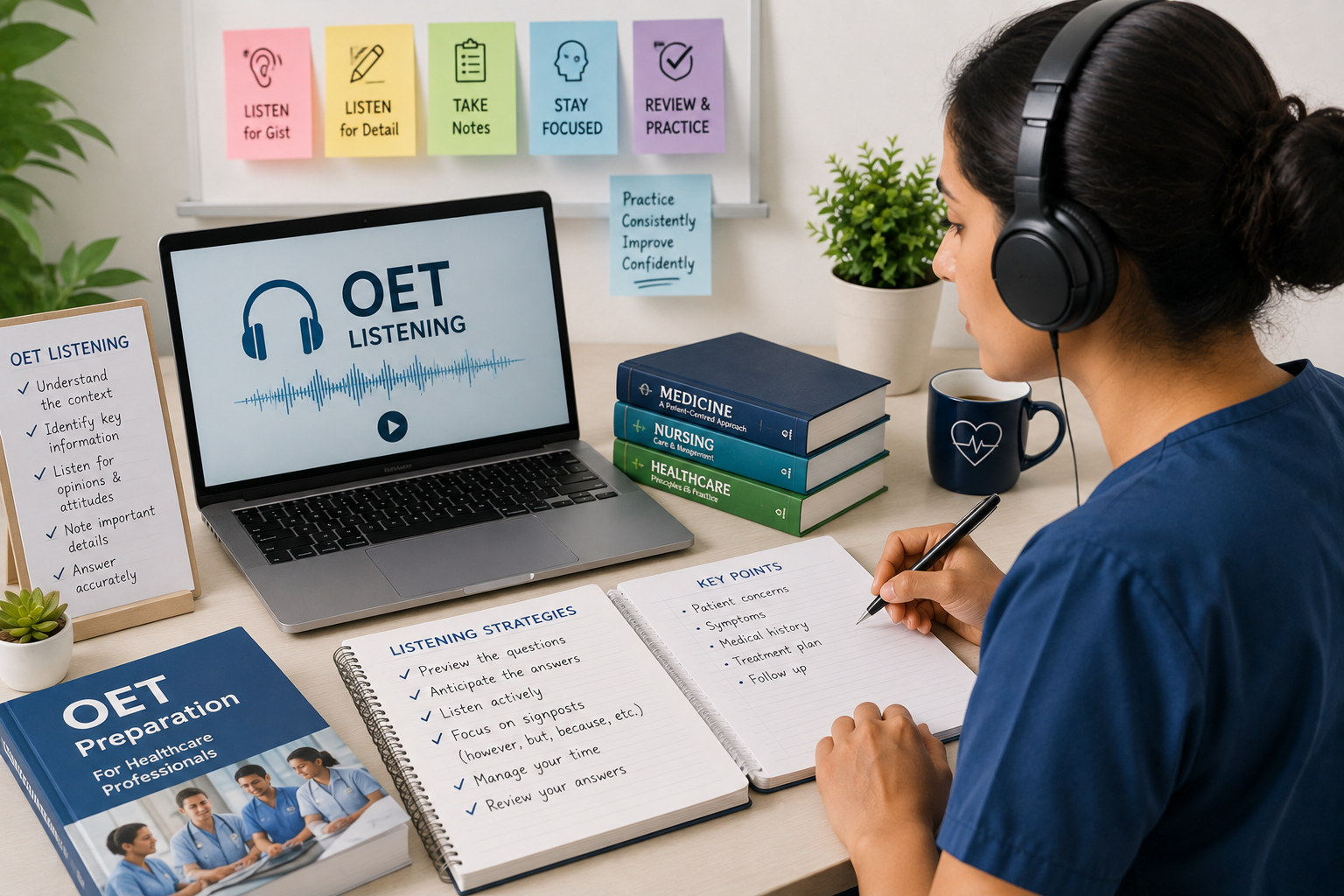

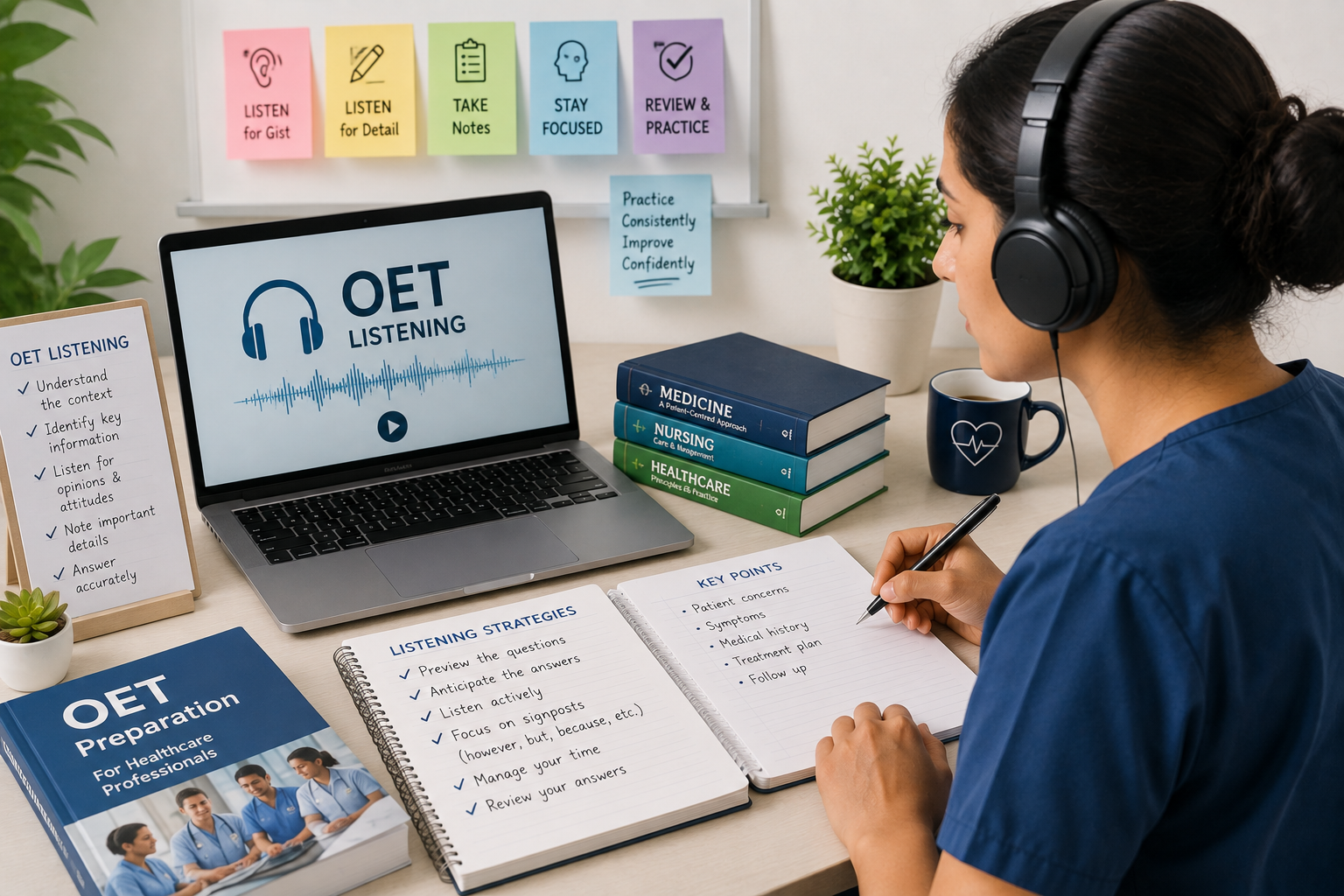
Preparing for the Occupational English Test (OET) requires more than general English knowledge. For healthcare professionals, the Listening sub-test assesses your ability to understand spoken English in realistic healthcare situations, including patient consultations, professional discussions, and presentations.
Strong listening skills are essential not only for achieving your required OET score but also for communicating safely and effectively in an English-speaking healthcare environment.
In this guide, we share practical OET Listening tips and strategies to help doctors, nurses, pharmacists, dentists, physiotherapists, and other healthcare professionals prepare with confidence.
What Is the OET Listening Sub-Test?
The OET Listening sub-test is designed to assess how well healthcare professionals understand spoken English in a healthcare context.
The test contains three parts, and you will listen to a range of healthcare-related recordings. These may include:
● Patient consultations
● Healthcare professional-patient conversations
● Professional discussions
● Interviews
● Presentations
● Workplace-related healthcare talks
The recordings are played once only, so effective preparation is essential.
Your goal is not to understand and memorise every single word. Instead, you need to identify the information that answers the questions accurately.
Understand the Three Parts of OET Listening
Before developing your preparation strategy, it is important to understand the different types of listening tasks.
Part A: Consultation Extracts
Part A includes two recorded consultations between a healthcare professional and a patient or caregiver.
You will usually complete notes based on the information you hear.
This section tests your ability to identify specific details such as:
● Symptoms
● Medical history
● Duration of a condition
● Medication
● Treatment
● Advice
● Lifestyle information
● Follow-up instructions
Part B: Short Workplace Extracts
Part B includes short recordings related to everyday healthcare communication.
These may involve:
● Team discussions
● Instructions
● Handover situations
● Brief workplace conversations
You will answer multiple-choice questions based on the main purpose, opinion, or key message of the speaker.
Part C: Presentation or Interview Extracts
Part C includes longer recordings, such as interviews or presentations on healthcare-related topics.
You will answer multiple-choice questions that test your understanding of:
● Main ideas
● Opinions
● Attitudes
● Arguments
● Purpose
● Important supporting information
Each part requires a slightly different listening strategy.
1. Read the Questions Before the Recording Starts
One of the most important OET Listening strategies is to use the preparation time effectively.
Before the recording begins, quickly read:
● The title
● The instructions
● The questions
● Any gaps or answer options
Try to predict the type of information you need to listen for.
For example, if the note says:
Duration of symptoms: ______
You already know that you should listen for a time period such as:
● Two days
● Several weeks
● Since last Friday
● For approximately three months
This helps you focus on relevant information instead of trying to understand every word.
2. Predict Possible Answers
Prediction is a powerful skill for the OET Listening test.
Look at the words before and after each gap and ask yourself:
● What type of word is missing?
● Is it likely to be a symptom?
● Do I need a number?
● Could the answer be medication?
● Am I listening for a date or duration?
● Is the missing word likely to be a noun, adjective, or verb?
For example:
Patient's main complaint: ______ pain
You may expect a word such as:
● Chest
● Back
● Abdominal
● Joint
Predicting possible answers prepares your brain to recognise the correct information quickly.
However, do not become too focused on one predicted answer. The recording may use unexpected vocabulary or paraphrasing.
3. Listen for Meaning, Not Individual Words
A common mistake is trying to understand every word in the recording.
This can cause you to miss important information.
Instead, focus on:
● The overall meaning
● Keywords
● Important details
● Changes in information
● The speaker's intention
For example, a patient may say:
"I initially thought it was just a mild headache, but over the last few days it has become much more severe."
The important information may not be the word headache alone. You also need to understand that the condition has worsened over time.
OET often tests your ability to understand information that is expressed in different ways.
4. Learn to Recognise Paraphrasing
The words you read in the question may not be the exact words used in the recording.
For example:
Question Possible Language in the Recording
Pain became worse The pain intensified
Patient is worried The patient is concerned
Stop taking the medicine Discontinue the medication
Difficulty sleeping Problems getting to sleep
Improvement Getting better
Developing your understanding of paraphrasing is especially important for Part B and Part C.
When practising, make a list of different ways common healthcare ideas can be expressed.
5. Pay Attention to Signposting Language
Speakers often use specific phrases to introduce important information.
These phrases can help you identify when an important point is coming.
Listen carefully for expressions such as:
● The main issue is...
● What concerns me most is...
● The important thing to remember is...
● However...
● On the other hand...
● The reason for this is...
● In contrast...
● To summarise...
● The key point is...
These expressions are particularly useful in OET Listening Part C, where you may need to understand the speaker's main argument or opinion.
6. Be Careful with Changes and Corrections
Healthcare conversations often contain information that changes during the discussion.
For example:
"I started taking the medication about three weeks ago—actually, it may have been closer to a month."
The correct answer is the final information, not necessarily the first detail you hear.
Listen carefully for correction signals such as:
● Actually
● Sorry
● I mean
● Rather
● No, it was...
● On second thought
● More accurately
This is especially important in Part A, where you need to record specific information accurately.
7. Do Not Panic If You Miss an Answer
Because the recordings are played only once, missing one answer can feel stressful.
However, do not spend the rest of the recording thinking about the answer you missed.
This can cause you to lose several more answers.
Instead:
1. Leave the answer temporarily.
2. Continue listening.
3. Focus on the next question.
4. Return to the unanswered question if you have an opportunity.
One missed answer should not affect your performance throughout the entire test.
8. Develop a Strategy for OET Listening Part A
Part A requires you to listen for specific information and complete notes.
Focus on the Question Order
The questions generally follow the order of information in the recording.
Therefore, once you identify where the conversation is, you can move through the questions in sequence.
Listen for the Exact Required Information
Avoid writing unnecessary information.
If the question asks for:
Frequency of headaches: ______
Write the frequency, not the full sentence spoken by the patient.
Check Grammar and Word Type
Use the words around the gap to understand what type of answer is required.
For example:
The patient has experienced symptoms for ______.
You should expect a duration.
Do Not Worry About Exact Spelling During Listening
Focus first on capturing the answer. During checking time, review spelling if necessary.
9. Use a Different Approach for Part B
OET Listening Part B often tests your understanding of the speaker's main message, purpose, or opinion.
Before listening:
● Read the question carefully.
● Identify what you need to understand.
● Review the answer options.
While listening, do not choose an answer immediately just because you hear a familiar word.
The correct answer is usually based on the meaning of the complete message.
Pay close attention to words that show:
● Purpose
● Advice
● Warnings
● Instructions
● Opinions
Ask yourself:
What is the speaker really trying to communicate?
10. Focus on Attitude and Opinion in Part C
Part C requires more advanced listening skills.
The correct answer may depend on understanding:
● The speaker's opinion
● Their attitude towards an issue
● Their reason for supporting or criticising something
● The main argument
● The meaning behind a statement
Listen for language that communicates attitude, such as:
● I strongly believe...
● I'm not entirely convinced...
● One of the biggest challenges is...
● What concerns me is...
● This could potentially lead to...
● I would argue that...
Do not select an answer simply because the recording contains the same word as one of the options.
Focus on the meaning and context.
11. Improve Your Healthcare Vocabulary
A strong healthcare vocabulary can make OET Listening much easier.
However, you do not need to memorise every medical term.
Focus on common vocabulary related to:
Symptoms
● Pain
● Dizziness
● Nausea
● Fatigue
● Shortness of breath
● Swelling
● Bleeding
Patient History
● Previous surgery
● Family history
● Allergies
● Medication history
● Lifestyle habits
● Existing conditions
Treatment
● Prescription
● Dosage
● Therapy
● Referral
● Follow-up
● Recovery
● Side effects
Healthcare Communication
● Assessment
● Recommendation
● Diagnosis
● Management
● Procedure
● Monitoring
● Discharge
The more familiar you are with healthcare vocabulary and everyday medical communication, the easier it becomes to follow recordings naturally.
12. Practise Listening to Different Accents
Healthcare professionals in English-speaking countries communicate with people from different linguistic and cultural backgrounds.
Therefore, it is important to become comfortable listening to different English accents.
During your preparation, practise listening to a variety of speakers.
Focus on understanding:
● The overall message
● Key information
● Pronunciation differences
● Connected speech
● Natural speaking speed
Avoid relying on subtitles during every practice session. Occasionally listening without reading along will help you develop stronger real-time listening skills.
13. Improve Your Ability to Understand Numbers and Details
Numbers can be particularly important in healthcare communication.
Practise listening for:
● Dates
● Times
● Ages
● Dosages
● Measurements
● Duration
● Frequency
For example:
● 15 milligrams
● Twice daily
● Three times a week
● 2.5 litres
● For approximately six months
Small mistakes with numbers can lead to incorrect answers, so include number-listening practice in your regular study routine.
14. Avoid Overthinking the Answer Options
In multiple-choice sections, several options may sound possible.
Do not select an answer simply because:
● You heard the same word.
● The option sounds medically logical.
● It is mentioned first.
Instead, wait for enough information to understand the speaker's complete message.
Look for evidence that clearly supports one option more than the others.
15. Practise Active Listening Every Day
Improving your listening skills requires regular exposure to spoken English.
Try to include active listening in your daily OET preparation.
You can practise with:
● OET-style listening materials
● Healthcare interviews
● Medical discussions
● English-language healthcare podcasts
● Professional presentations
After listening, ask yourself:
● What was the main topic?
● What was the speaker's main point?
● What details were important?
● Did the speaker change their opinion?
● Which words or phrases were paraphrased?
This approach helps you become an active listener rather than simply hearing the recording.
16. Analyse Your Mistakes After Every Practice Test
Taking practice tests is useful, but analysing mistakes is even more important.
After each OET Listening practice test, review every incorrect answer.
Ask yourself why you got it wrong.
Was it because:
● You did not understand the vocabulary?
● You missed a keyword?
● You misunderstood a paraphrase?
● You selected an answer too early?
● You lost concentration?
● You misunderstood the speaker's opinion?
● You made a spelling mistake?
Create an OET Listening error log and track repeated mistakes.
For example:
Mistake Type Problem Improvement Strategy
Vocabulary Unknown medical terms Learn vocabulary in context
Paraphrasing Missed similar meaning Practise synonyms
Concentration Lost focus Complete timed practice
Multiple choice Selected too early Wait for complete meaning
Numbers Misheard details Practise dates, dosage and measurements
Over time, you will identify the areas that need the most improvement.
17. Practise Under Real Test Conditions
Once you understand the test format, regularly practise under realistic exam conditions.
This means:
● Complete the test without interruptions.
● Listen to the recording only once.
● Follow the correct timing.
● Avoid pausing or replaying the audio.
● Check your answers carefully.
Practising this way helps you develop:
● Concentration
● Time management
● Confidence
● Listening stamina
It also prepares you for the pressure of the actual OET exam.
18. Build Your Concentration and Listening Stamina
OET Listening requires consistent concentration from beginning to end.
If you lose focus for even a few seconds, you may miss important information.
To improve concentration:
● Study in a quiet environment.
● Use headphones when practising.
● Avoid checking your phone.
● Complete longer listening exercises.
● Take short breaks between study sessions.
● Gradually increase the length of your practice.
Regular practice can help you stay focused for the entire listening sub-test.
A Simple OET Listening Preparation Routine
A structured routine can help healthcare professionals improve consistently.
Daily Practice
15–20 minutes: Healthcare vocabulary and paraphrasing
20–30 minutes: OET-style listening practice
10–15 minutes: Review mistakes
10 minutes: Listen to authentic English healthcare content
The most important factor is consistency. Even regular short practice sessions can help improve your ability to understand spoken English.
Final OET Listening Tips for Test Day
Before the test, remember these key strategies:
● Read the questions carefully before listening.
● Predict the type of information you need.
● Focus on meaning rather than every individual word.
● Watch for paraphrasing.
● Listen carefully for corrections and changes.
● Do not panic if you miss one answer.
● Follow the order of the questions.
● Pay attention to the speaker's purpose, attitude and opinion.
● Avoid choosing multiple-choice answers too early.
● Use practice tests to identify weak areas.
● Stay focused and move on quickly if you miss information.
Prepare for OET with the Right Strategy
Success in OET Listening is not only about having a large English vocabulary. It requires active listening, concentration, understanding paraphrasing, recognising key information, and applying the right strategy for each part of the test.
As a healthcare professional, you may already be familiar with many of the situations and topics used in OET. The key is to develop the English listening skills needed to understand information accurately and respond effectively under test conditions.
With regular practice, targeted feedback, and a clear understanding of the Listening sub-test, you can improve your confidence and work towards achieving your required OET score.
At ONT Global, we support healthcare professionals with structured guidance and preparation strategies to help them approach English language and professional registration requirements with greater confidence.
Start by adding a full OET Listening practice session to your weekly study plan and use your mistakes to identify the skills you need to improve next.