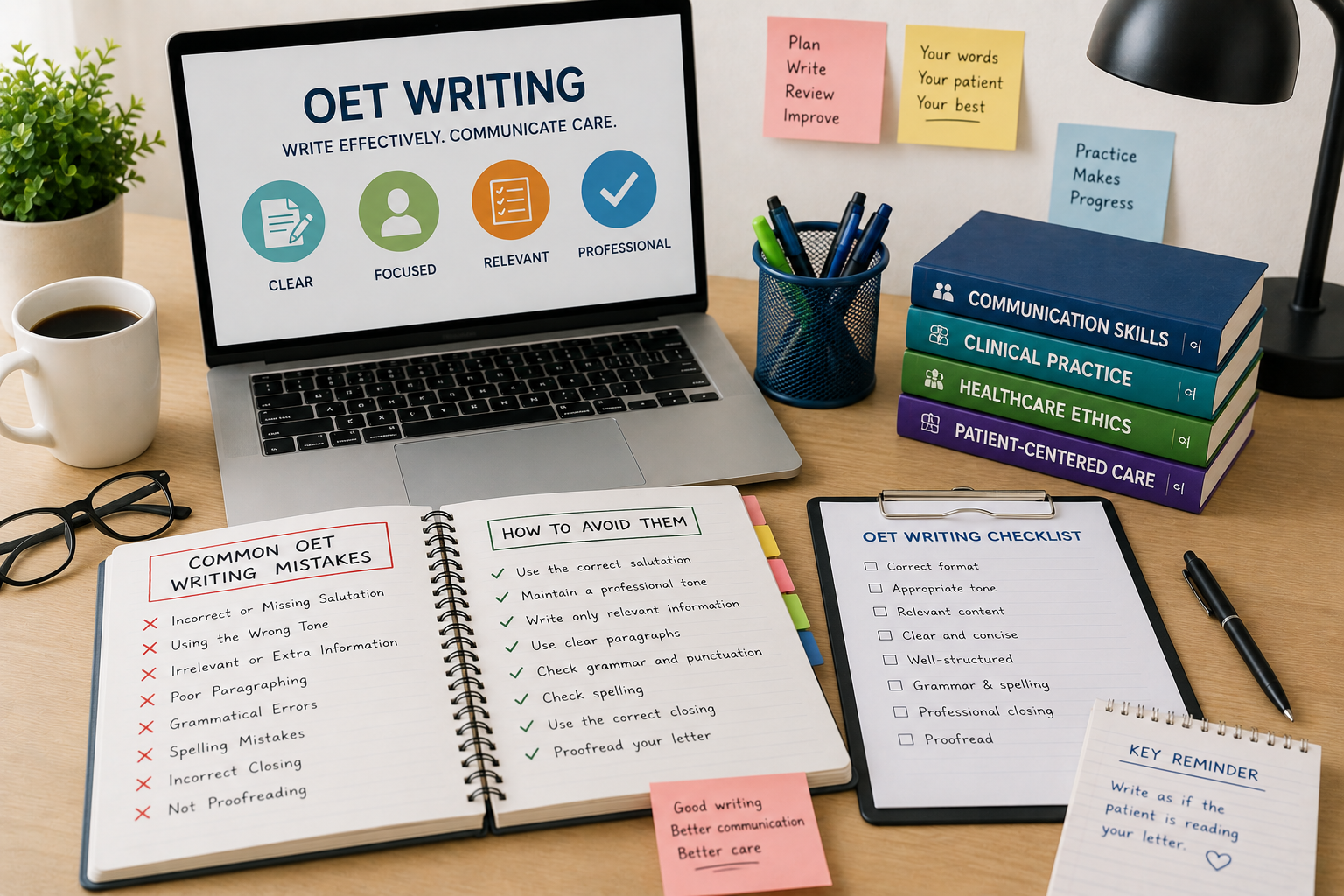
Common OET Writing Mistakes and How to Avoid Them
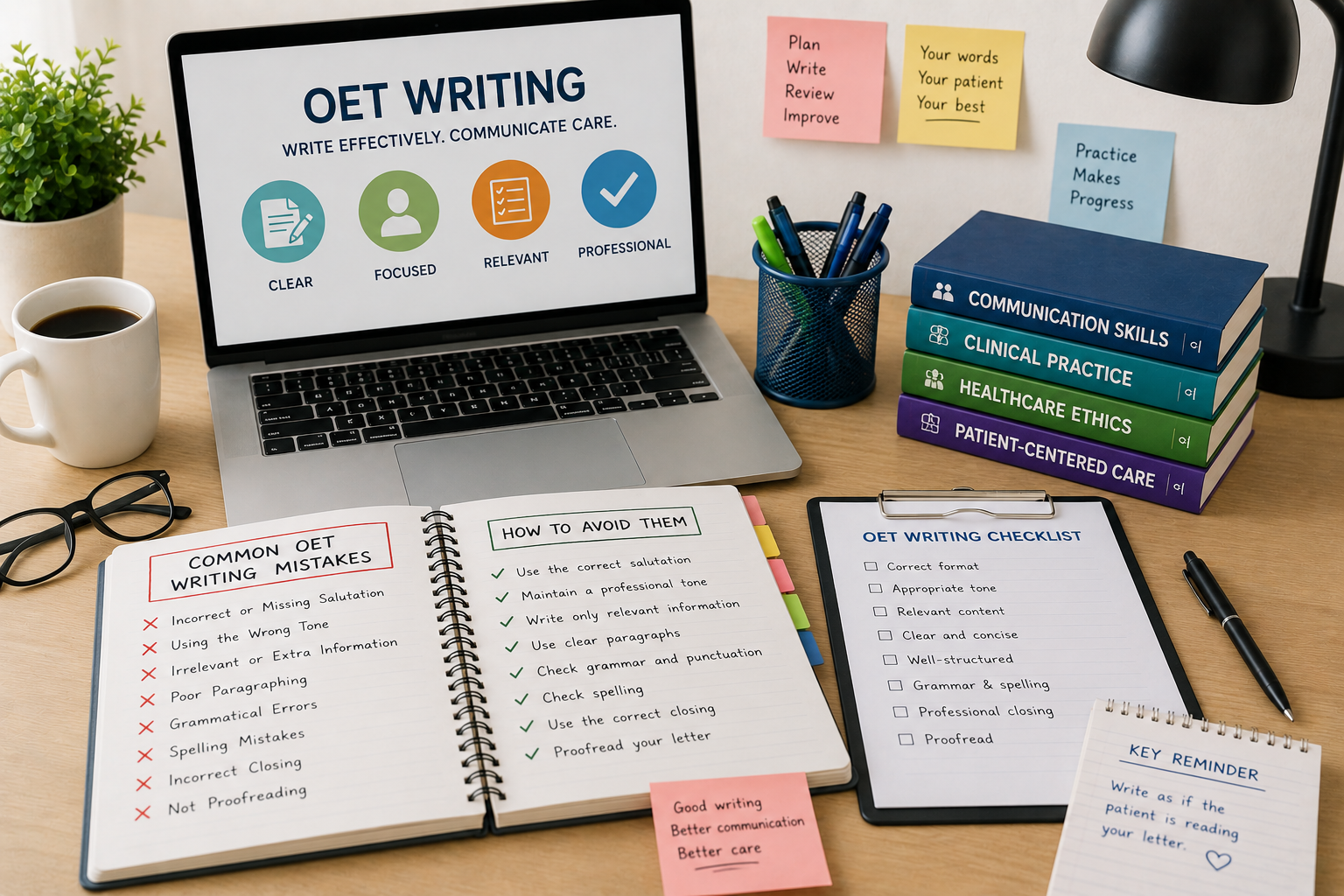

The OET Writing sub-test is designed to assess how effectively healthcare professionals can communicate important information in a professional healthcare setting. Candidates are typically required to write a letter based on a set of case notes, such as a referral letter, discharge letter, transfer letter, or advice letter.
Although many candidates have strong medical knowledge and a good level of English, they may still lose marks because of common mistakes in content selection, organisation, language, tone, and letter-writing conventions. OET Writing is not simply about including every detail from the case notes. Instead, candidates must identify the most relevant information and present it clearly for the intended reader.
Understanding the most common OET Writing mistakes can help you improve your performance and write a clear, concise, and professional letter.
In this guide, we explore the most common OET Writing mistakes and practical strategies to avoid them.
1. Including Too Much Information
One of the most common mistakes in OET Writing is trying to include every piece of information from the case notes.
Many candidates believe that more information will result in a better score. However, this is not necessarily true. The reader only needs information that is relevant to the purpose of the letter.
For example, if you are writing a referral letter to a physiotherapist, the recipient may need information about:
● The patient's current condition
● Relevant medical history
● Symptoms affecting mobility
● Previous treatment
● The reason for referral
However, unrelated information may not be necessary.
How to Avoid This Mistake
Before writing your letter, ask yourself:
Does the reader need this information to understand the patient's condition or provide appropriate care?
If the answer is no, leave it out.
Focus on the purpose of the letter and the needs of the reader rather than attempting to copy all the case notes.
2. Missing Important Information
While including unnecessary information is a problem, leaving out important information can also negatively affect your score.
Candidates may focus heavily on grammar and vocabulary but forget essential clinical details. This can make the letter incomplete or unclear.
For example, a referral letter may need to include:
● The patient's current diagnosis
● Relevant symptoms
● Important medical history
● Treatment already provided
● The specific reason for referral
If any critical information is missing, the recipient may not have a complete understanding of the situation.
How to Avoid This Mistake
Spend the first few minutes carefully analysing the case notes.
Identify:
1. Who is the reader?
2. Why are you writing the letter?
3. What action do you want the reader to take?
4. Which information is essential for that purpose?
Highlight or mentally group the most relevant information before you begin writing.
3. Copying the Case Notes Directly
Another common mistake is copying sentences or phrases directly from the case notes.
Case notes are often written in short forms, abbreviations, and note-style language. Simply converting them into full sentences without organising the information properly can make the letter sound unnatural.
For example:
Case notes:
SOB × 3 days, worsening at night, prescribed inhaler.
A weak approach would be:
The patient has SOB for three days and it is worsening at night and an inhaler was prescribed.
A more professional version could be:
The patient has experienced worsening shortness of breath over the past three days, particularly during the night. An inhaler was prescribed to manage these symptoms.
How to Avoid This Mistake
Do not copy the notes word for word.
Instead:
● Understand the meaning of the information.
● Select relevant details.
● Combine related information.
● Use complete and natural sentences.
● Organise the details logically.
Your goal is to transform the case notes into a clear professional communication.
4. Poor Organisation of Information
A letter may contain all the correct information but still be difficult to read if it is poorly organised.
Some candidates write information in the same order as it appears in the case notes. However, case notes are not always arranged in the best order for a professional letter.
For example, the reader may first need to know:
● Why you are writing
● The patient's current condition
● Relevant background information
● Previous management
● The requested action
How to Avoid This Mistake
Organise your letter into clear paragraphs.
A simple structure may include:
Paragraph 1: Purpose of the Letter
Clearly explain why you are writing.
Paragraph 2: Current Situation
Describe the patient's current condition, symptoms, or diagnosis.
Paragraph 3: Relevant Background
Include medical history or other information relevant to the recipient.
Paragraph 4: Management and Request
Explain treatment already provided and what you would like the recipient to do.
A well-organised letter allows the reader to quickly understand the most important information.
5. Writing an Unclear Purpose Statement
The opening paragraph is extremely important because it tells the reader why you are writing.
A vague opening can create confusion.
For example:
I am writing regarding Mr Smith.
This sentence does not clearly explain the purpose of the letter.
A stronger version would be:
I am writing to refer Mr Smith, who has been experiencing persistent lower back pain, for further assessment and management.
The reader immediately understands the purpose of the communication.
How to Avoid This Mistake
Make sure your purpose statement answers the following question:
Why is this letter being written?
Use clear and direct language.
Examples include:
● I am writing to refer...
● I am writing to discharge...
● I am writing to request...
● I am writing to provide further information regarding...
● I am writing to transfer the care of...
A clear purpose statement helps create a strong first impression.
6. Using the Wrong Tone
OET Writing requires an appropriate professional tone.
Some candidates use language that is too informal, while others make their writing unnecessarily complicated.
For example, an informal sentence may be:
Please check the patient and see what you can do.
A more professional version would be:
I would appreciate your further assessment and management of the patient's condition.
However, overly complicated language can also reduce clarity.
How to Avoid This Mistake
Use professional but natural language.
Choose language that is:
● Clear
● Respectful
● Appropriate for healthcare communication
● Easy for the reader to understand
Avoid trying to impress the examiner with unnecessarily complex vocabulary.
7. Overusing Medical Terminology
Healthcare professionals may be comfortable using medical terminology, but the level of technical language should depend on the intended reader.
If the letter is addressed to another healthcare professional, relevant medical terminology may be appropriate. However, if the reader is a patient or a non-medical professional, highly technical language may not be suitable.
How to Avoid This Mistake
Always consider the recipient.
Ask yourself:
What level of information and terminology would this reader understand and expect?
Adapt your language accordingly.
Effective communication means choosing language that is appropriate for the specific audience.
8. Using Too Many Abbreviations
Abbreviations are common in healthcare settings, but excessive use can make a letter difficult to understand.
Some abbreviations may also have different meanings depending on the healthcare system or professional context.
How to Avoid This Mistake
Avoid using abbreviations unless they are:
● Widely understood
● Appropriate for the recipient
● Necessary for clear communication
When in doubt, write the full term.
For example, instead of using multiple shortened forms, write the information clearly and naturally.
Clarity should always be more important than saving a few words.
9. Writing Long and Complicated Sentences
Long sentences with multiple ideas can lead to grammatical mistakes and make the letter difficult to follow.
For example:
The patient came to the clinic last week because she was experiencing severe pain and she also mentioned that she had previously experienced similar symptoms and she was given medication but it did not improve her condition.
This sentence contains too many ideas.
A clearer version would be:
The patient attended the clinic last week with severe pain. She reported experiencing similar symptoms previously, for which she had received medication. However, her condition did not improve.
How to Avoid This Mistake
Keep your sentences focused.
Try to communicate one main idea at a time.
Use:
● Full stops
● Appropriate linking words
● Clear sentence structures
Shorter, well-structured sentences are often more effective than long and complicated ones.
10. Repeating the Same Information
Some candidates repeat important information several times throughout the letter.
For example, the patient's diagnosis may appear in the introduction, background paragraph, and conclusion without a clear reason.
Repetition can make the letter unnecessarily long and reduce its effectiveness.
How to Avoid This Mistake
Include each important piece of information where it makes the most sense.
Before completing your letter, check whether you have repeated:
● The diagnosis
● Symptoms
● Treatment
● Dates
● Referral reasons
Remove unnecessary repetition while ensuring the letter remains clear.
11. Poor Paragraphing
Writing one large block of text can make it difficult for the reader to identify important information.
Similarly, creating too many very short paragraphs can interrupt the flow of the letter.
How to Avoid This Mistake
Group related information together.
For example:
● Paragraph 1: Purpose of the letter
● Paragraph 2: Current condition
● Paragraph 3: Relevant medical history
● Paragraph 4: Treatment and request
Each paragraph should have a clear purpose.
Good paragraphing improves readability and helps the recipient locate important information quickly.
12. Using Inappropriate Linking Words
Linking words can improve the flow of your writing, but overusing them can make your letter sound unnatural.
For example:
Furthermore, the patient attended the clinic. Moreover, she reported pain. In addition, medication was prescribed.
This sounds repetitive and unnatural.
How to Avoid This Mistake
Use linking words only when they improve the connection between ideas.
Useful examples include:
● However
● Therefore
● Consequently
● In addition
● Despite this
● Following this
● As a result
Do not force linking words into every sentence.
13. Focusing Too Much on Advanced Vocabulary
Some candidates believe they need to use difficult vocabulary to achieve a high score.
However, inappropriate or incorrectly used advanced vocabulary can reduce clarity.
For example, using a complicated word when a simple and accurate word would be better can make the sentence sound unnatural.
How to Avoid This Mistake
Prioritise:
● Accuracy
● Clarity
● Appropriate vocabulary
● Natural professional language
Use words that you understand and can use correctly.
Simple and accurate language is better than complicated language used incorrectly.
14. Making Frequent Grammar Mistakes
Grammar mistakes can affect the clarity and professionalism of your letter.
Common errors include:
● Incorrect verb tenses
● Subject-verb agreement errors
● Incorrect articles
● Incorrect prepositions
● Sentence fragments
● Incorrect punctuation
For example:
The patient have been suffering from pain.
Correct:
The patient has been suffering from pain.
How to Avoid This Mistake
During your practice sessions, identify the grammar mistakes you make repeatedly.
Create a personal grammar checklist.
For example:
● Have I used the correct tense?
● Do the subject and verb agree?
● Have I used articles correctly?
● Are my sentences complete?
● Have I used punctuation correctly?
Improving your common grammar weaknesses can make a significant difference in your writing performance.
15. Incorrect Use of Tenses
OET letters often require candidates to describe:
● Past medical history
● Current symptoms
● Recent treatment
● Future recommendations
This means correct tense selection is important.
For example:
Past Events
The patient was diagnosed with diabetes in 2022.
Current Situation
She is currently experiencing persistent fatigue.
Recent or Ongoing Situation
She has been experiencing symptoms for the past two weeks.
Future Action
I would appreciate your further assessment and management.
How to Avoid This Mistake
Pay attention to the timeline of events.
Ask yourself:
Did this happen in the past, is it happening now, or is it expected to happen in the future?
Choose your tense accordingly.
16. Writing Outside the Recommended Word Range
OET Writing requires candidates to communicate the necessary information concisely. Writing significantly more than required can lead to unnecessary details, repetition, and poor time management.
Writing too little may also mean that important information has been omitted.
How to Avoid This Mistake
Practise writing concise letters.
During preparation:
● Avoid unnecessary background information.
● Combine related details.
● Remove repetition.
● Focus on the purpose of the letter.
● Include only information relevant to the reader.
The goal is not to write as much as possible. The goal is to write exactly what the reader needs.
17. Spending Too Much Time Reading and Planning
Planning is essential, but some candidates spend too much time analysing the case notes and leave insufficient time for writing and checking the letter.
How to Avoid This Mistake
Develop a consistent time-management strategy.
A practical approach is:
Task Suggested Focus
Reading case notes Identify the purpose, reader, and relevant information
Planning Organise the information into logical groups
Writing Develop the letter clearly and professionally
Checking Review grammar, spelling, relevance, and clarity
Practise under timed conditions so that you become comfortable managing your time effectively.
18. Not Proofreading the Letter
Many candidates complete their letter and stop immediately.
However, a final review can help identify small mistakes that may affect clarity and accuracy.
Common mistakes that can be identified during proofreading include:
● Spelling errors
● Incorrect names
● Incorrect dates
● Grammar mistakes
● Missing words
● Repeated information
● Unclear sentences
How to Avoid This Mistake
Always leave time for a final review.
Check the following:
● Is the purpose clear?
● Have I included all essential information?
● Have I included unnecessary information?
● Is the information logically organised?
● Is the tone professional?
● Are grammar and spelling correct?
● Is the letter easy to understand?
A few minutes of proofreading can improve the overall quality of your response.
A Simple OET Writing Checklist
Before submitting your OET Writing task, ask yourself:
● Is the purpose of the letter clear?
● Have I identified the correct reader?
● Have I selected only relevant information?
● Have I included all essential information?
● Is my letter logically organised?
● Have I used appropriate paragraphs?
● Is my tone professional?
● Is my language clear and concise?
● Have I avoided unnecessary abbreviations?
● Have I used correct grammar and tenses?
● Have I avoided repetition?
● Have I checked spelling and punctuation?
Using a checklist regularly during practice can help you develop stronger writing habits.
How to Improve Your OET Writing Skills
Improving your OET Writing score requires regular and focused practice.
Here are some effective strategies:
Practise with Different Letter Types
Do not practise only one type of letter.
Work on different tasks, including:
● Referral letters
● Discharge letters
● Transfer letters
● Advice letters
● Letters requesting further assessment or management
This will help you become familiar with different communication purposes.
Analyse High-Quality Sample Letters
Study strong OET Writing samples to understand:
● How information is selected
● How paragraphs are organised
● How the purpose is introduced
● How professional language is used
Do not memorise entire letters. Instead, learn useful structures and communication techniques.
Get Feedback on Your Writing
Feedback can help you identify mistakes that you may not notice yourself.
Pay attention to repeated weaknesses in areas such as:
● Content selection
● Organisation
● Grammar
● Vocabulary
● Conciseness
Work on one or two weaknesses at a time.
Practise Under Exam Conditions
Timed practice can help you improve:
● Reading speed
● Case note analysis
● Planning
● Writing speed
● Proofreading
The more you practise under realistic conditions, the more confident you can become on test day.
Avoiding common OET Writing mistakes is not about memorising complicated vocabulary or writing long letters. Success depends on your ability to understand the purpose of the letter, identify the relevant information, organise it logically, and communicate clearly in a professional tone.