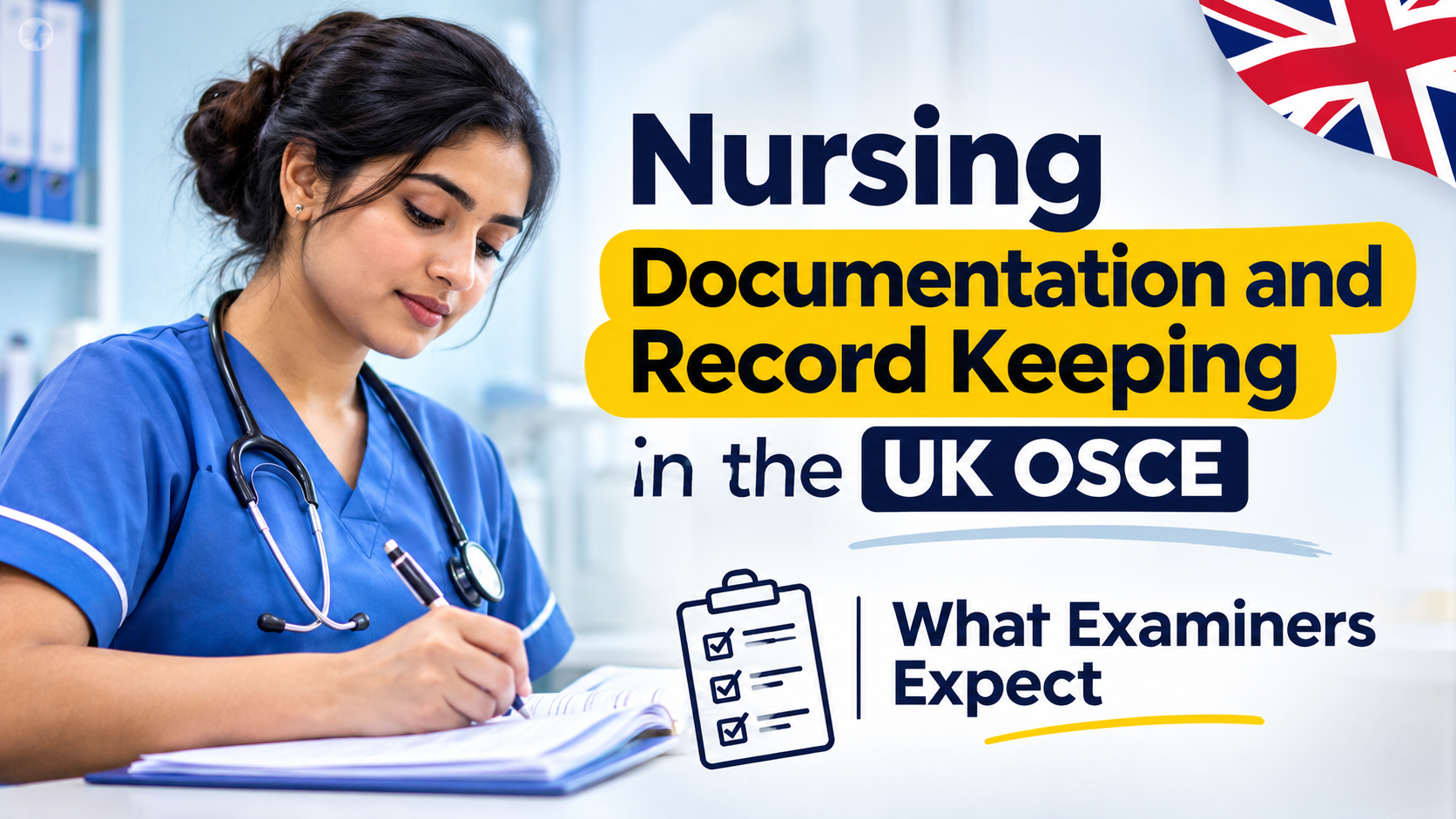
Nursing Documentation and Record Keeping in the UK OSCE: What Examiners Expect

Accurate nursing documentation and record keeping are essential
responsibilities of every registered nurse. In the UK, maintaining clear,
complete and accurate patient records is not simply an administrative task. It
is a fundamental part of patient safety, professional accountability and
effective communication between healthcare professionals.
For internationally educated nurses preparing for the UK Nursing Objective Structured
Clinical Examination (OSCE), understanding UK documentation
standards is particularly important. Examiners assess more than your ability to
perform clinical procedures. They also expect you to demonstrate that you can
accurately record patient information, document nursing interventions,
recognise changes in a patient's condition and communicate important findings
appropriately.
Whether you are completing an Assessment, Planning, Implementation and
Evaluation (APIE) station or a clinical skills station, documentation plays an
important role in demonstrating safe and professional nursing practice.
In this guide, we explain the essential principles of nursing
documentation, what OSCE examiners expect, common documentation mistakes and
how you can improve your performance.
Nursing documentation refers to the systematic recording of relevant
information about a patient's health, assessment, care, treatment and progress.
It provides a written or electronic record of the care delivered and
supports communication between members of the healthcare team.
In UK nursing practice, documentation may include:
●
Patient identification details
●
Initial nursing assessments
●
Vital signs and clinical observations
●
Nursing care plans
●
Medication administration records
●
Fluid intake and output charts
●
Pain assessment records
●
Wound assessment and dressing records
●
Changes in a patient's condition
●
Clinical interventions and patient responses
●
Escalation of concerns
●
Patient consent and relevant discussions
●
Handover information
During the OSCE,
candidates may be asked to complete specific documentation forms depending on
the station and clinical scenario.
The important principle is to ensure that every entry is relevant,
accurate, clear and professionally recorded.
Documentation is closely connected to patient safety and professional
accountability.
A nurse may perform a clinical procedure correctly, but failing to
document the findings or intervention can affect continuity of care and
communication.
OSCE examiners expect candidates to understand that documentation is
an essential part of the nursing process.
Nurses are responsible for the accuracy of the records they create or
contribute to.
Documentation provides evidence of assessments, clinical decisions,
nursing interventions and patient responses.
Accurate records help healthcare professionals identify changes in a
patient's condition, recognise potential risks and make appropriate clinical
decisions.
For example, recording abnormal observations can help demonstrate the
need for timely escalation.
Patient records allow nurses and other healthcare professionals to
understand what has happened, what care has been provided and what actions may
be required next.
Clear documentation helps ensure that patients receive consistent care
when responsibility transfers between nurses, shifts or healthcare teams.
Nursing records provide an account of care delivered and support
professional accountability, clinical review and appropriate audit processes.
The Nursing and Midwifery Council (NMC) sets professional standards
for nurses and midwives practising in the UK.
The NMC Code, particularly the section on practising effectively,
requires nurses to maintain clear and accurate records relevant to their
practice.
According to the Code, nurses should ensure that records are:
●
Completed at the time the events happen or as
soon as possible afterwards.
●
Accurate and free from speculation.
●
Recorded without unnecessary jargon or
abbreviations.
●
Written clearly and legibly.
●
Dated and timed.
●
Attributable to the person who made the entry.
●
Kept securely and confidentially.
Nurses must also ensure that records are not falsified, altered
inappropriately or left incomplete.
These principles are important throughout the UK Nursing OSCE because
candidates are expected to demonstrate professional practice consistent with
the NMC Code.
Understanding the following principles can help you complete
documentation accurately and professionally during your examination.
Always document information based on your assessment, observations and
actions.
Avoid guessing, making assumptions or recording findings that you have
not actually obtained.
For example:
Incorrect: "Patient seems to be feeling better."
Better: "Patient reports that pain has reduced from 7/10 to 3/10
following the prescribed intervention."
The second entry provides specific information that can be understood
and reviewed by other healthcare professionals.
Every nursing entry should include the relevant date and time.
This helps establish when an assessment was performed, an intervention
was provided or a change in the patient's condition was identified.
During the OSCE, do not forget to complete the date and time fields on
the documentation provided.
Nursing documentation must be attributable to the person making the
entry.
Follow the instructions on the relevant documentation form and
applicable local requirements for recording your name, signature, designation
or electronic authentication.
Never leave a required identification field incomplete.
Write in simple, factual and professional language.
Avoid informal expressions, unclear wording and unnecessary
abbreviations.
For example:
Incorrect: "Pt was bad and breathless."
Better: "Patient reports shortness of breath. Respiratory rate
measured at 28 breaths per minute."
Clear documentation reduces the risk of misunderstanding.
Records should be completed at the time of the event or as soon as
possible afterwards.
If documentation is delayed, follow the relevant policy for making a
late entry. Do not backdate or make it appear that the entry was written
earlier than it actually was.
Do not document only normal observations.
Abnormal findings and significant changes in a patient's condition
must be recorded accurately.
For example, if a patient's blood pressure, respiratory rate or oxygen
saturation is outside the expected range, record the actual measurement and
take appropriate action.
Remember that documentation does not replace escalation. You must
respond to clinical concerns promptly.
Record the relevant nursing interventions you have performed.
Depending on the scenario, this may include:
●
Medication administration
●
Wound dressing
●
Catheter care
●
Personal care
●
Patient repositioning
●
Oxygen therapy, where prescribed or
appropriately authorised
●
Clinical observations
●
Communication with other healthcare
professionals
Follow the relevant documentation requirements for each intervention.
Documentation should include how the patient responded to the care or
intervention.
For example, after a pain-relief intervention, record the patient's
reported pain score and any relevant changes observed during reassessment.
This demonstrates that you have evaluated the effectiveness of the
care provided.
Patient information must be handled securely and shared only with
appropriate individuals for legitimate professional purposes.
During the OSCE, avoid discussing identifiable patient information in
inappropriate places or leaving documentation exposed to unauthorised people.
Mistakes in nursing records must be corrected transparently and in
accordance with the relevant documentation policy.
For paper records, follow the approved correction procedure, which
commonly involves drawing a single line through the incorrect entry while
keeping the original information readable, adding the correct information and
including the date, time and authentication.
Never erase, overwrite, use correction fluid or falsify an entry.
For electronic records, follow the approved system's correction and
audit-trail procedures.
The OSCE may involve different documentation requirements depending on
the station.
Candidates should become familiar with completing assessment forms,
care plans, observation charts and other relevant clinical records.
Here is a practical approach to follow.
Before starting, understand the patient's situation and the specific
task.
Identify:
●
Patient details
●
Presenting symptoms
●
Relevant medical history
●
Clinical observations
●
Identified risks
●
Required nursing interventions
Do not rush into completing documentation without understanding the
scenario.
Complete the relevant assessment using an appropriate systematic
approach.
For example, when assessing a patient, you may need to:
●
Confirm the patient's identity.
●
Explain the assessment.
●
Obtain consent.
●
Assess the presenting complaint.
●
Measure relevant observations.
●
Identify abnormal findings.
●
Recognise immediate safety concerns.
Record the findings accurately on the appropriate chart or assessment
form.
Enter the information in the correct sections of the documentation
provided.
Ensure that:
●
All relevant fields are completed.
●
Measurements are recorded accurately.
●
Units are included where required.
●
Findings are factual.
●
Date and time are entered.
●
Your required signature or authentication is
included.
Document the interventions you have completed and any relevant
discussions with the patient.
Do not record an intervention as completed if you have only planned or
discussed it.
Review the patient's condition following the intervention.
Record relevant changes, including:
●
Improvement or deterioration
●
Repeat observations
●
Pain score changes
●
Patient feedback
●
Outstanding concerns
If you identify abnormal findings or a deterioration in the patient's
condition, take appropriate action without delay.
Communicate relevant information to the appropriate healthcare
professional using a structured approach such as SBAR:
S – Situation: Explain the immediate concern.
B – Background: Provide relevant patient history and context.
A – Assessment: Explain your clinical findings.
R – Recommendation: State what action or support is required.
Ensure that significant communication and actions are documented
appropriately.
Consider the following practice scenario.
Scenario:
A patient reports pain around a post-operative wound. During your
assessment, you identify redness around the wound and the patient reports pain
rated 7/10.
You complete the relevant assessment, document your findings and
escalate the concern appropriately.
Example documentation:
|
Documentation
Field |
Example Entry |
|
Date |
12/11/2026 |
|
Time |
09:30 |
|
Assessment |
Patient reports pain around the post-operative wound. |
|
Pain Score |
7/10, as reported by patient. |
|
Wound Assessment |
Redness observed around the wound. Further assessment required. |
|
Nursing Action |
Patient informed that the findings require clinical review. |
|
Escalation |
Concern communicated to the appropriate registered nurse/clinical
team for review. |
|
Evaluation |
Further assessment and review pending. |
|
Signature |
Candidate's name/signature, as required by the form. |
Important: This is an educational example, not a
universal clinical record template. In an actual OSCE, record only the findings
you have assessed, use the information supplied in the scenario and follow the
station instructions.
The example demonstrates an important principle: documentation should
describe what the patient reported, what you observed, what action you took and
what happened next.
Many candidates focus heavily on clinical procedures but overlook
documentation details.
Even small mistakes can affect the quality and completeness of their
performance.
Here are some common errors to avoid.
Leaving the date or time blank makes it difficult to establish when an
event occurred.
How to avoid it: Make date and time part of your routine
documentation checklist.
An entry should be attributable to the person who completed it.
How to avoid it: Check the authentication or signature field
before completing the station.
Unfamiliar abbreviations may cause confusion and misinterpretation.
How to avoid it: Use clear, professional language and only
approved abbreviations where appropriate.
Avoid documenting opinions or conclusions without supporting
assessment findings.
How to avoid it: Record what the patient tells you, what you
observe and what you measure.
Recording observations without recognising or documenting abnormal
results can compromise patient safety.
How to avoid it: Review your findings, identify concerns and
escalate appropriately.
Completing a procedure without recording the relevant intervention can
result in incomplete documentation.
How to avoid it: Include the care provided and the patient's
response where relevant.
Identifying a problem is not enough. You must communicate concerns
appropriately.
How to avoid it: Record who was informed, when the
communication took place and any relevant action or advice received.
Long sentences, informal expressions and unnecessary technical terms
can reduce clarity.
How to avoid it: Keep your entries concise, factual and
organised.
The APIE framework is an important part of UK Nursing OSCE preparation.
It stands for Assessment, Planning, Implementation and Evaluation.
Documentation supports all four stages.
1. Assessment
Record the patient's history, symptoms, clinical observations and
identified needs.
2. Planning
Document appropriate, individualised nursing goals and planned
interventions.
3. Implementation
Record the nursing care and interventions actually delivered.
4. Evaluation
Document the patient's response and whether the planned outcomes have
been achieved.
Understanding this connection helps candidates demonstrate a
structured approach to nursing care rather than treating documentation as a
separate administrative task.
If you are an internationally educated nurse, adapting to UK
documentation expectations may require additional practice.
The following strategies can help.
Become familiar with common nursing documents, including:
●
Nursing assessment forms
●
Care planning documents
●
Vital signs charts
●
Fluid balance charts
●
Medication administration records
●
Wound assessment forms
●
Pain assessment charts
Complete documentation as part of your regular mock OSCE practice.
Practising under timed conditions can help you improve your accuracy
and time management.
Read the NMC Code and focus particularly on professional
accountability, effective communication, confidentiality and accurate record
keeping.
Do not simply memorise documentation formats.
Understand why particular information needs to be recorded and how it
affects patient care.
Ask your OSCE trainer or tutor to review your documentation.
Identify missing information, unclear entries and repeated errors.
Regular feedback can help you improve your confidence and consistency.
Before completing a documentation task, review the following
checklist.
●
Correct patient details are recorded.
●
Relevant assessment findings are documented.
●
Observations and measurements are accurate.
●
Abnormal findings are identified and recorded.
●
Nursing interventions are documented
correctly.
●
Patient responses are recorded where relevant.
●
Appropriate escalation is demonstrated.
●
Date and time are included.
●
Signature or authentication is completed.
●
Language is clear, factual and professional.
●
Confidentiality is maintained.
●
All relevant sections of the form are
completed.
Remember that the exact documentation requirements depend on the
station instructions and assessment criteria. Always prioritise patient safety
and follow the official OSCE guidance.
Successful OSCE preparation involves
more than memorising clinical procedures. You must demonstrate safe nursing
practice, professional communication, clinical reasoning and accurate
documentation.
Understanding UK nursing
documentation standards can help you approach assessment, care planning,
clinical skills and evaluation stations with greater confidence.
At ONT Global, we support internationally educated nurses in
preparing for their UK nursing journey through structured learning and OSCE
preparation support.
With regular practice, expert guidance and a clear understanding of
NMC professional expectations, you can strengthen your clinical skills and
prepare to demonstrate safe, effective and professional nursing practice.
Start your UK Nursing OSCE preparation journey with ONT Global today!
Educational Disclaimer: This article is intended for
educational and OSCE preparation purposes. It does not replace the NMC Code,
official NMC OSCE preparation materials, clinical supervision, local NHS
policies or professional clinical judgement. Always refer to the latest official
guidance and relevant clinical procedures.