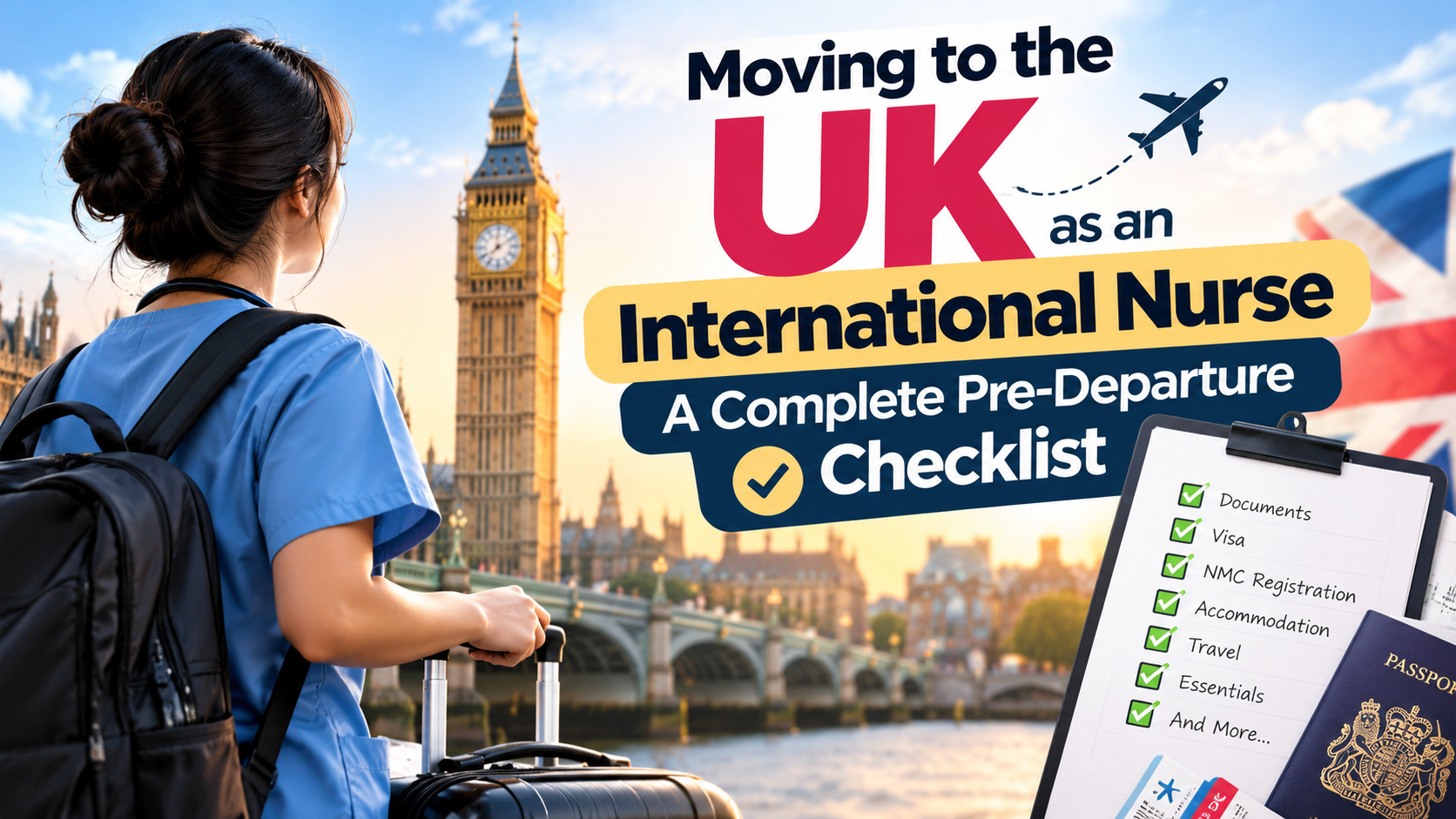
Moving to the UK as an International Nurse: Registration, Visa and Relocation Checklist

Moving to the UK as an international nurse can be an important step
towards building a rewarding healthcare career. The United Kingdom offers
opportunities to work in hospitals, community healthcare settings and
specialist clinical departments while gaining valuable professional experience.
However, relocating to another country involves more than securing a
nursing job. International nurses must understand the professional registration
process, meet applicable English language requirements, obtain the correct
immigration permission, prepare essential documents and arrange practical
matters such as accommodation, travel and finances.
Whether you are a nurse from India, the Philippines, Nigeria or
another country, preparing in advance can make your transition smoother and
help you approach your new career with confidence.
This guide explains the key steps involved in moving to the UK as an
international nurse, from starting your Nursing and Midwifery Council (NMC)
registration application to settling into your new home.
Before practising as a registered nurse in the UK,
internationally educated nurses generally need to complete the appropriate
registration process with the Nursing and Midwifery Council (NMC).
The NMC regulates nurses and midwives across the UK and nursing
associates in England. Its registration requirements help ensure that
professionals have the knowledge, skills and professional standards necessary
to provide safe and effective care.
The exact route depends on your qualifications, training, registration
history and individual circumstances.
Before starting your application, make sure you:
●
Review the NMC requirements for
internationally educated nurses.
●
Check your eligibility for the relevant
registration route.
●
Gather your nursing degree or diploma
certificates and academic transcripts.
●
Prepare evidence of your professional
registration and qualifications.
●
Arrange any additional documents requested by
the NMC.
●
Check the applicable English language
requirements.
●
Prepare for the required assessments, if
applicable.
●
Monitor your application and complete any
outstanding steps.
●
Follow the NMC's instructions for identity
verification and final registration.
Depending on your circumstances, you may need to complete the NMC Test
of Competence, which includes a computer-based test (CBT) and a
practical
Objective Structured Clinical Examination (OSCE).
The NMC determines which requirements apply to your application. Check
the official guidance before booking assessments or making relocation
arrangements.
Official resource: NMC registration for
internationally trained nurses
English language proficiency is essential for safe nursing practice.
Nurses must be able to communicate effectively with patients, relatives,
colleagues and other healthcare professionals.
The NMC accepts specified forms of evidence to demonstrate English
language proficiency. Depending on your circumstances, these may include IELTS
Academic, Occupational
English Test (OET), or another evidence route permitted by the
NMC.
●
Review the latest NMC English language
requirements.
●
Check the accepted test types and required
scores.
●
Prepare for IELTS Academic or OET if
applicable.
●
Confirm that your results meet the relevant
validity requirements.
●
Organise supporting evidence if you intend to
use an alternative accepted route.
●
Practise clinical communication, patient
handovers and healthcare documentation.
●
Check whether your employer has any additional
English language requirements.
Remember that NMC registration requirements and immigration
requirements are related but distinct. Confirm that your evidence meets the
rules applicable to both processes.
Official resource: NMC
English language requirements
Some internationally educated nurses must complete the NMC Test of
Competence as part of their registration journey.
The CBT assesses relevant nursing knowledge and can be taken at
approved locations outside the UK. The OSCE evaluates practical clinical skills
and decision-making through structured clinical scenarios at an approved UK
test centre.
Your required assessments will depend on the NMC route applicable to
you.
Focus your preparation on:
●
Nursing knowledge and clinical
decision-making.
●
Patient safety and risk assessment.
●
Infection prevention and control.
●
Medication safety and dosage calculations.
●
Professional accountability and ethical
practice.
●
Relevant nursing procedures and clinical
guidelines.
For the practical assessment, concentrate on:
●
Structured patient assessment.
●
Clinical communication and handovers.
●
Accurate documentation.
●
Safe medication administration.
●
Infection prevention procedures.
●
Recognising and escalating patient
deterioration.
●
Applying professional standards in clinical
scenarios.
Practising realistic scenarios can help you understand UK nursing
expectations and improve your confidence.
ONT Global provides nursing preparation support, including CBT and
OSCE-related courses. Explore the available programmes to identify the
preparation that suits your current stage.
A suitable job offer is an important part of planning your move,
particularly if you intend to apply for a sponsored work visa.
International nurses can explore opportunities with NHS organisations
and other eligible healthcare employers. Before accepting an offer, verify the
role, employer, salary, working arrangements and sponsorship conditions.
●
What is the official job title and clinical
speciality?
●
Where will I be based?
●
What salary and NHS pay band, where
applicable, will I receive?
●
What shift patterns and weekly hours should I
expect?
●
Is the employer authorised to sponsor the
relevant visa?
●
Does the role meet the current immigration
eligibility requirements?
●
What registration or competency requirements
must I complete before starting?
●
Will the employer provide induction,
preceptorship or OSCE support?
●
Is accommodation or relocation assistance
available?
●
Which costs will the employer cover, and which
will I need to pay?
Read the employment contract carefully and request written
confirmation of any benefits or financial assistance.
Be cautious of recruiters who promise guaranteed registration, visas
or jobs in exchange for unexplained payments. Verify the employer and
recruitment arrangements before transferring money or sharing sensitive
documents.
Official resource: UK
government guidance on applying for health and social care jobs from abroad.
Many eligible international nurses use the Health and Care Worker visa
route to work in the UK.
Eligibility depends on factors including your occupation, approved
employer, sponsorship arrangements and salary. You must have a qualifying job
offer and a Certificate of Sponsorship (CoS) from your employer before
applying.
A job offer alone does not give you permission to enter or work in the
UK.
Before submitting your application:
●
Confirm that your nursing role is eligible.
●
Check that your employer is an approved
sponsor.
●
Obtain your Certificate of Sponsorship
reference number.
●
Verify your job title, occupation code and
salary.
●
Prepare a valid passport or other accepted
identity document.
●
Arrange proof of English language proficiency
as required.
●
Check whether a tuberculosis test is required
for your circumstances.
●
Obtain any required criminal record
certificates.
●
Prepare supporting documents for eligible
dependants, if applicable.
●
Complete the visa application and identity
verification process.
●
Check the outcome of your application and any
immigration conditions.
The documents required vary according to individual circumstances. You
should therefore follow the current Home Office instructions rather than
relying on a general checklist alone.
The Health and Care Worker visa has specific rules covering eligible
employment, salary, sponsorship, dependants and changes of employer. Check
these conditions before accepting a job or making travel arrangements.
The visa application fee and other potential expenses should also be
included in your relocation budget. Eligible Health and Care Worker visa
applicants are exempt from the Immigration Health Surcharge, although some NHS
services may still involve charges.
Official resources:
●
Documents
required for a Health and Care Worker visa
Preparing your paperwork in advance can prevent delays during
recruitment, registration, visa processing and onboarding.
Create a dedicated folder for your original documents, certified
copies and secure digital backups. Keep important travel and immigration
documents in your hand luggage when travelling.
●
Valid passport.
●
Visa decision or evidence of immigration
permission, as applicable.
●
Birth certificate, where required.
●
Marriage certificate or children's birth
certificates, if relevant.
●
Certified translations of documents where
required.
●
Nursing degree or diploma certificate.
●
Academic transcripts.
●
Nursing registration certificate from your
home country.
●
Employment experience letters.
●
Professional references.
●
English language test results, where
applicable.
●
NMC correspondence and registration evidence.
●
Relevant training and professional development
certificates.
●
Signed employment contract.
●
Job offer letter.
●
Certificate of Sponsorship details, if
applicable.
●
Employer contact details and joining
instructions.
●
Pre-employment and occupational health
documentation.
●
Accommodation confirmation.
●
Flight booking and travel itinerary.
●
Details of any relocation assistance agreed
with your employer.
Check that your name and other personal details are consistent across
your documents. Resolve discrepancies before they create problems during
official checks.
Moving to the UK requires careful financial planning. Even when an
employer provides sponsorship or relocation assistance, you may have personal
expenses before receiving your first salary.
Prepare a budget that covers the initial weeks and allows for
unexpected costs.
|
Expense category |
What to consider |
|
Travel |
Flights, baggage and onward transport |
|
Accommodation |
Temporary housing, rent and deposit |
|
Food and essentials |
Groceries, meals and household supplies |
|
Local transport |
Bus, train or commuting costs |
|
Communication |
Mobile SIM and data plan |
|
Clothing |
Weather-appropriate clothing and work essentials |
|
Documentation |
Translations, certificates and applicable assessment fees |
|
Emergency savings |
Unexpected expenses or delayed salary payments |
Ask your employer which expenses are covered and whether any
reimbursement conditions apply. Keep written records of agreed payments and
retain receipts for eligible claims.
Avoid relying on financial assistance until its terms have been
confirmed.
Finding a suitable place to live is an important part of relocating as
an international nurse.
Your choice of accommodation will depend on your workplace, budget,
shift pattern and personal circumstances. Living near your hospital or
healthcare facility may make commuting easier, particularly when working night
shifts or early starts.
●
Ask whether your employer provides temporary
or long-term accommodation.
●
Research rental properties close to your
workplace.
●
Compare rent, transport expenses and local
amenities.
●
Check whether utilities are included.
●
Understand the tenancy agreement and deposit
arrangements.
●
Confirm the move-in date and access details.
●
Research nearby supermarkets, pharmacies and
public transport.
●
Arrange temporary accommodation if your
permanent housing is not ready.
Verify the property and landlord before making payments. Never
transfer a deposit to an unverified person or agree to unclear rental terms.
If possible, arrange temporary accommodation for your first few days
so that you have time to inspect longer-term options.
Relocation involves adapting to a new environment as well as starting
a new job. Understanding daily life and professional expectations can help you
settle in more comfortably.
Pack clothing suitable for the season and location. Waterproof
outerwear, comfortable footwear and layers can be useful when temperatures and
weather conditions change.
Before starting your new role, familiarise yourself with:
●
The NMC Code and professional accountability.
●
Patient confidentiality and data protection.
●
Infection prevention and control.
●
Safeguarding responsibilities.
●
Medication safety and accurate documentation.
●
Clinical handovers and escalation procedures.
●
Patient-centred care and multidisciplinary
teamwork.
Your employer will explain local policies and mandatory training
during induction. Be prepared to ask questions and seek guidance when
unfamiliar with a procedure.
Connect with colleagues, local communities and other internationally
educated nurses. A supportive network can help you learn about transport,
housing, shopping and cultural differences while adjusting to your new
surroundings.
Taking time to settle into your new environment can make the
transition more manageable.
Once you arrive, prioritise the essential tasks that will help you
settle in and prepare for work.
●
Reach your accommodation safely and confirm
access arrangements.
●
Contact your employer to confirm your joining
date and reporting location.
●
Check that your immigration status and
employment arrangements are in order.
●
Complete outstanding identity and
pre-employment checks.
●
Follow your employer's instructions for
payroll and National Insurance arrangements.
●
Arrange a UK mobile connection and local
transport.
●
Locate nearby supermarkets, pharmacies and
healthcare services.
●
Register with a local GP when appropriate.
●
Attend your workplace induction and mandatory
training.
●
Confirm your responsibilities, supervision and
any outstanding competency requirements.
●
Keep copies of important employment and
immigration documents.
Your employer may also offer support with airport pickup, temporary
accommodation, local orientation or settling-in arrangements. Confirm which
services are available before you travel.
Even well-prepared applicants can experience delays if important
details are overlooked.
Here are some common mistakes to avoid:
Starting registration too late: Review the NMC
process early and allow time for document verification, assessments and any
additional requirements.
Assuming a job offer guarantees a visa: Confirm
sponsorship eligibility and complete the appropriate immigration process.
Ignoring changing requirements: Check official NMC
and UK government guidance regularly, especially before submitting applications
or booking travel.
Underestimating living costs: Budget for rent,
deposits, transport and essential purchases before your first salary arrives.
Accepting unclear employment terms: Read your contract
and confirm salary, working hours, sponsorship and relocation support in
writing.
Paying unverified recruiters: Check the
legitimacy of recruitment agencies and be cautious of unrealistic promises or
unexplained charges.
Travelling without essential documents: Keep your
passport, visa evidence, employment details and other required paperwork
accessible throughout your journey.
Planning ahead and checking each requirement carefully can reduce
avoidable stress.
The process depends on the job and the stage of your registration.
Some employers may recruit internationally educated nurses while they complete
specified registration requirements, subject to the applicable immigration and
employment rules. You must meet the requirements for the role and cannot
practise as a registered nurse until appropriately registered with the NMC.
Many nurses with eligible sponsored jobs apply for the Health and Care
Worker visa. You must satisfy the applicable requirements for the occupation,
employer, salary and Certificate of Sponsorship. Always check the latest
official guidance for your circumstances.
The NMC requires acceptable evidence of English language proficiency.
IELTS Academic and OET are possible routes, but other forms of evidence may be
accepted under the NMC's rules. Check the latest requirements before choosing a
test.
Not necessarily. The required assessments depend on your registration
route and individual circumstances. Review the NMC guidance to confirm which
assessments apply to you.
There is no single amount suitable for every nurse. Your budget will
depend on the destination, accommodation, travel, family circumstances and
employer support. Calculate your expected expenses and maintain an emergency
reserve where possible.
Your partner and children may be eligible to apply as dependants under
the relevant visa rules. Eligibility depends on the immigration route and
individual circumstances, so confirm the current requirements before making
family travel arrangements.
Follow your employer's joining instructions, complete outstanding
checks, arrange essential services and attend your induction. Make sure you
understand your responsibilities, supervision arrangements and any registration
or competency requirements before starting clinical duties.
Moving to the UK as an international nurse requires careful
preparation, from professional registration and English language proficiency to
employment, visa arrangements and relocation planning.
By organising your documents, checking official requirements and
preparing for the practical aspects of moving abroad, you can approach each
stage of the journey with greater confidence.
ONT Global supports aspiring international nurses through nursing
preparation and training opportunities, including CBT, OSCE, IELTS and OET
courses. Whether you are beginning your registration journey or preparing for
the next stage of your UK nursing career, choosing the right preparation can
help you work towards your professional goals.
Explore the relevant courses, review your requirements and begin
planning your next steps today.
Take the next step with ONT Global: Visit ONT
Global to explore available nursing preparation courses and support.