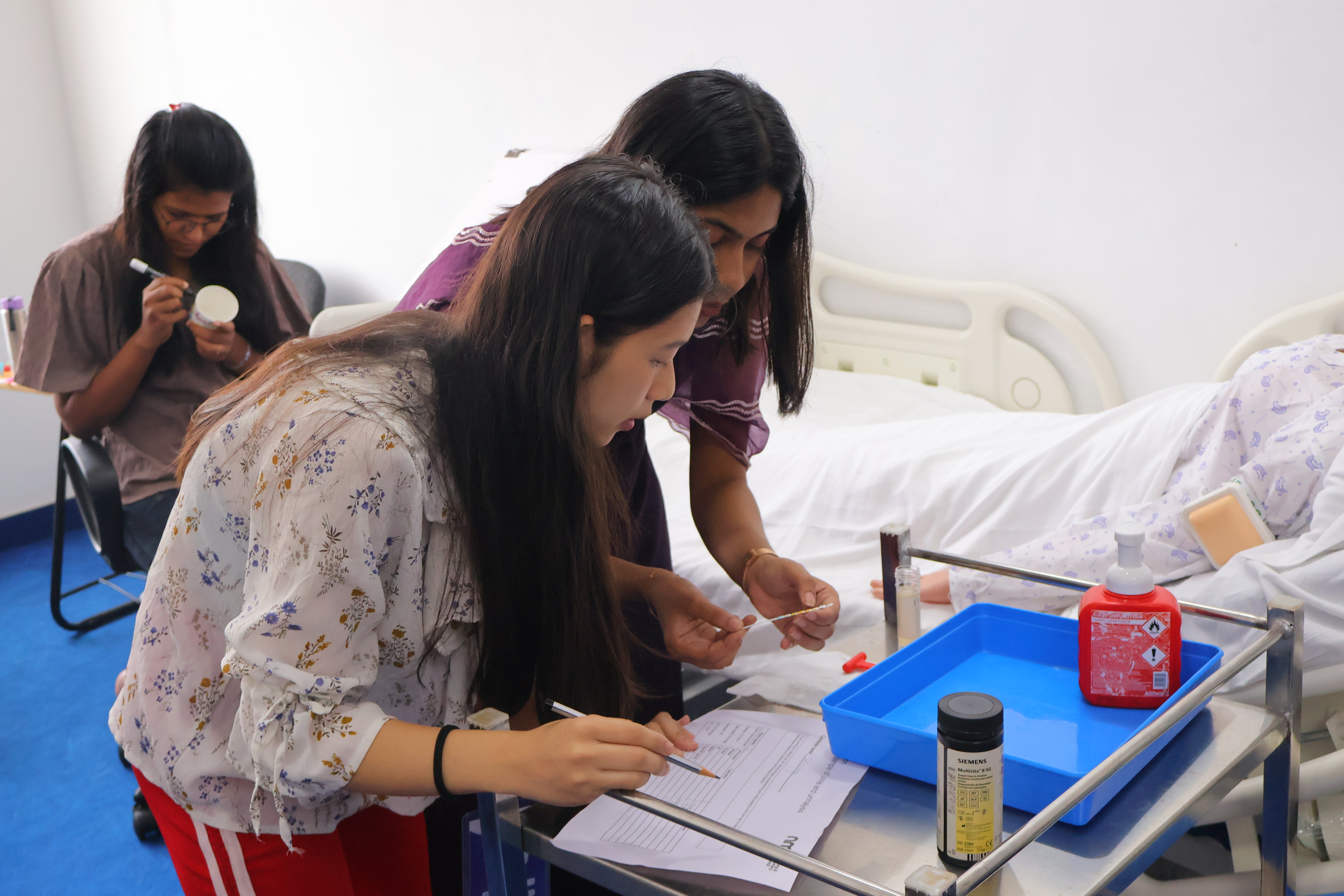
Top 10 Common OSCE Mistakes and How to Avoid Them


Preparing for the Objective Structured Clinical Examination (OSCE) can be challenging, especially for
internationally educated nurses preparing for registration in the UK. The OSCE is not
simply a test of how much clinical information you can remember. It assesses
whether you can apply your knowledge, clinical skills, communication,
professional judgement and patient-safety principles in a practical setting.
For nurses taking the UK
Nursing and Midwifery Council (NMC) Test of Competence, the OSCE is the
practical part of the assessment. The current nursing OSCE consists of 10
stations, covering the APIE process, clinical skills, values and behaviours,
and evidence-based practice. Many candidates make avoidable mistakes because
they focus heavily on memorising procedures while overlooking communication,
documentation, safety checks and station instructions.
The good news is that most
common OSCE mistakes can be prevented with structured preparation and regular
practice.
Here are the top 10
common OSCE mistakes and how to avoid them.
One of the most common
OSCE mistakes is starting the station without properly understanding the
scenario.
Candidates may become
nervous when the timer starts and immediately begin performing the skill.
However, the instructions contain important information about the patient, your
role, the task and what you are expected to demonstrate.
The NMC specifically
identifies failure to read scenarios and instructions accurately as a common
mistake.
If you misunderstand the
task, you may:
● Perform the wrong procedure
● Miss an important part of the assessment
● Complete unnecessary steps
● Forget required documentation
● Waste valuable time
Before starting, carefully
read the station information and identify:
● Who is the patient?
● What is your role?
● What exactly are you being asked to do?
● What information has already been provided?
● What needs to be assessed, documented or
communicated?
● How much time do you have?
Tip: Do not rush simply because you see the
countdown timer. Spend the available reading time understanding the task before
you begin.
Hand hygiene is a basic
but essential part of safe nursing practice.
Candidates sometimes
become focused on the clinical procedure and forget to perform hand hygiene at
the appropriate point.
The NMC lists touching the
patient before performing appropriate hand hygiene as a common OSCE error.
Hand hygiene is directly
related to infection prevention and patient safety. Missing it can affect your
assessment even if you perform the rest of the procedure correctly.
Make hand hygiene an
automatic part of your routine.
Before patient contact:
Stop → Hand hygiene →
Introduce yourself → Confirm identity → Explain → Gain consent → Continue with
the procedure
However, always follow the
specific station instructions and current clinical guidance.
When practising at home or
in a skills lab, physically include hand hygiene in your routine rather than
simply saying:
"I would perform
hand hygiene."
Developing the correct
habit makes it easier to remember during the real examination.
OSCEs assess more than
technical skills. Communication is an important part of safe and professional
nursing practice.
Some candidates focus
entirely on completing the procedure and forget to communicate with the patient
throughout the station.
The NMC identifies poor
verbal and non-verbal communication, including not listening to the patient, as
a common mistake.
● Not introducing yourself
● Using inappropriate terminology
● Not explaining the procedure
● Speaking too quickly
● Not listening to the patient's concerns
● Failing to check understanding
● Ignoring non-verbal cues
● Not maintaining professional communication
Treat the patient as a
person, not as a checklist.
For example:
Introduce yourself →
Confirm identity → Explain the procedure → Gain consent → Communicate
throughout → Check comfort → Explain next steps
Use clear, professional
language and avoid unnecessary medical jargon.
You are demonstrating how
you would communicate with a real patient in clinical practice—not simply
trying to impress the examiner.
Safety checks are
fundamental to nursing practice.
Candidates may become
nervous and move directly into the clinical skill without completing important
preliminary checks.
The NMC specifically
highlights failure to check patient identity, allergies and consent among
common OSCE errors.
● Patient identity
● Relevant allergies
● Patient's condition
● Consent
● Safety
● Appropriate equipment
● Relevant clinical information
For medication-related
stations, candidates should pay particular attention to the medication chart
and relevant safety checks. The NMC also identifies errors involving medication
charts, expiry dates and incorrect doses as examples of common mistakes.
Create a consistent safety
routine.
A useful approach is:
Identify → Explain →
Consent → Check → Perform → Evaluate → Document
Always adapt this to the
specific station and current NMC preparation materials.
Many candidates prepare by
memorising every step of a procedure word-for-word.
Although knowing the
correct sequence is useful, relying entirely on memorisation can become a
problem when the scenario changes.
The NMC states that the
OSCE is designed to assess candidates' ability to apply knowledge to patient
care, rather than simply remember and recite facts. Candidates are expected
to practise at the level of a newly registered nurse in the UK.
The scenario presented
during the examination may not be exactly the same as the example you
practised.
If you have memorised a
script without understanding the reason behind each step, you may struggle
when:
● The patient's condition changes
● The scenario is presented differently
● You are asked an unexpected question
● You need to respond to a safety concern
● You need to use clinical judgement
Instead of asking:
"What sentence
should I memorise?"
Ask:
"Why am I doing
this step?"
Understand:
● What the procedure is
● Why it is performed
● What risks are involved
● What patient-safety issues must be considered
● What you should do if something goes wrong
● What should be documented
Understanding the
reasoning behind the procedure makes you much more adaptable.
OSCE stations are timed,
and candidates need to complete the required tasks within the allocated time.
One common mistake is
spending too much time on one part of the station and then rushing through the
remaining tasks.
The NMC identifies failure
to complete the required assessment, paperwork or station within the allotted
time as a common error.
● Over-explaining
● Repeating steps unnecessarily
● Spending too long on documentation
● Becoming stuck on one task
● Not practising with a timer
● Panicking when the clock is running
Practise under realistic
examination conditions.
Use a timer during your
mock OSCE sessions.
After each practice
station, ask:
● Did I complete every required task?
● Where did I lose time?
● Did I spend too long explaining something?
● Did I leave documentation until too late?
● Which steps need to become more automatic?
Do not sacrifice patient
safety simply to finish quickly.
The goal is safe,
structured and efficient practice, not simply speed.
7. Making Documentation
Errors
Documentation is another
area where candidates can lose marks.
Some candidates
concentrate so heavily on the practical procedure that they underestimate the
importance of accurate documentation.
The NMC identifies
incomplete or inaccurate documentation, illegible documentation and
unrecognised abbreviations among common errors.
● Missing important information
● Incorrect dates or times
● Incomplete assessment information
● Poor handwriting
● Unrecognised abbreviations
● Missing evaluation information
● Failure to document relevant findings
Practice documentation as
part of every relevant mock station.
Do not treat it as an
optional final step.
Before completing the
station, ask:
"Have I
documented everything the scenario requires?"
Use appropriate
terminology and follow the documentation requirements provided in the official
preparation materials.
A common mistake is
continuing with a procedure even when the candidate notices a potential error.
For example, candidates
may recognise that something is incorrect but become afraid to stop because
they think stopping will make them look uncertain.
In reality, recognising
and responding appropriately to a safety issue is an important part of
professional nursing practice.
The NMC's OSCE guidance
emphasises patient safety and public protection, and its preparation materials
include errors that candidates commonly fail to identify or manage correctly.
If you identify an error
or potential risk:
Patient safety comes
before completing the task.
Do not continue an unsafe
procedure simply because you are worried about the timer.
Watching videos and
reading notes can help you understand OSCE procedures, but passive learning
alone is not enough.
The OSCE is a practical
assessment. You need to demonstrate the skill.
The NMC recommends using
its preparation materials, mock OSCE materials, marking criteria and station
timings as part of preparation.
A candidate may think:
"I have watched
the procedure many times, so I know it."
But knowing what someone
else is doing is different from being able to perform it yourself.
Create realistic mock OSCE
sessions.
Practise:
● With a timer
● With a partner acting as the patient
● With someone observing your performance
● Using realistic equipment
● Using the correct documentation
● Without constantly checking your notes
After each practice
session, record your mistakes.
Create a simple OSCE
error log:
|
Mistake |
Why it happened |
Correct action |
Repeated? |
|
Forgot hand hygiene |
Nervousness |
Include it in opening
routine |
No |
|
Missed consent |
Rushed |
Add to safety checklist |
Yes |
|
Documentation incomplete |
Poor time management |
Practise timed
documentation |
No |
This helps turn mistakes
into learning opportunities.
OSCE anxiety is extremely
common.
When candidates become
nervous, they may forget simple steps they normally perform correctly.
The NMC has highlighted
anxiety as a factor that can increase the likelihood of errors and OSCE
failure, and recommends appropriate support and preparation.
● Speaking too quickly
● Forgetting routine steps
● Losing concentration
● Repeating information
● Freezing during a procedure
● Looking at the examiner for reassurance
● Rushing toward the end
The best way to build
confidence is not to eliminate nervousness completely—it is to become
comfortable performing while nervous.
Try:
● Regular timed practice
● Mock examinations
● Deep breathing before a station
● Positive self-talk
● Repeating difficult stations
● Practising your opening routine
● Reviewing mistakes rather than fearing them
Before starting a station,
take a breath and focus on the task in front of you.
Do not think about
the previous station. Do not think about the next station. Focus on the current
patient and current task.
Before your examination,
use this checklist to review the most common errors:
|
Check |
Question |
|
📖 Scenario |
Did I read and
understand the instructions? |
|
🧼 Hand hygiene |
Did I perform
appropriate hand hygiene? |
|
👤 Identification |
Did I correctly identify
the patient? |
|
💬 Communication |
Did I communicate
clearly and professionally? |
|
✅ Consent |
Did I explain the
procedure and gain consent? |
|
⚠️ Safety |
Did I identify and
manage safety risks? |
|
💊 Medication |
Did I complete the
relevant medication safety checks? |
|
⏱️ Timing |
Did I manage the station
effectively? |
|
📝 Documentation |
Did I complete all
required documentation? |
|
🔍 Evaluation |
Did I evaluate the
patient's response and next steps where required? |
Avoid preparing only by
memorising station scripts.
Instead, use a three-stage
preparation strategy.
Read the official NMC
preparation materials and understand what each station requires.
Learn:
● Clinical principles
● Patient-safety requirements
● Communication
● Documentation
● Professional behaviour
● Relevant evidence and guidance
The NMC advises candidates
to use its official preparation materials and understand and apply the NMC Code
throughout their OSCE preparation.
Perform the stations
repeatedly.
Start slowly.
Focus on performing each
step correctly before introducing time pressure.
Once you are comfortable,
recreate the examination environment.
Use:
● Timers
● Mock scenarios
● Practice patients
● Equipment
● Documentation
● Independent observers
The more realistic your
practice becomes, the more comfortable you are likely to feel on examination
day.
Passing the OSCE is not
about being perfect. It is about demonstrating that you can provide safe,
effective and professional patient care at the expected level of practice. The
most common mistakes are often not complicated clinical errors. They can be simple
things such as failing to read instructions carefully, forgetting hand hygiene,
poor communication, missing consent, incomplete documentation or poor time
management.
Prepare smart.
Practice consistently. Stay calm. Put patient safety first.