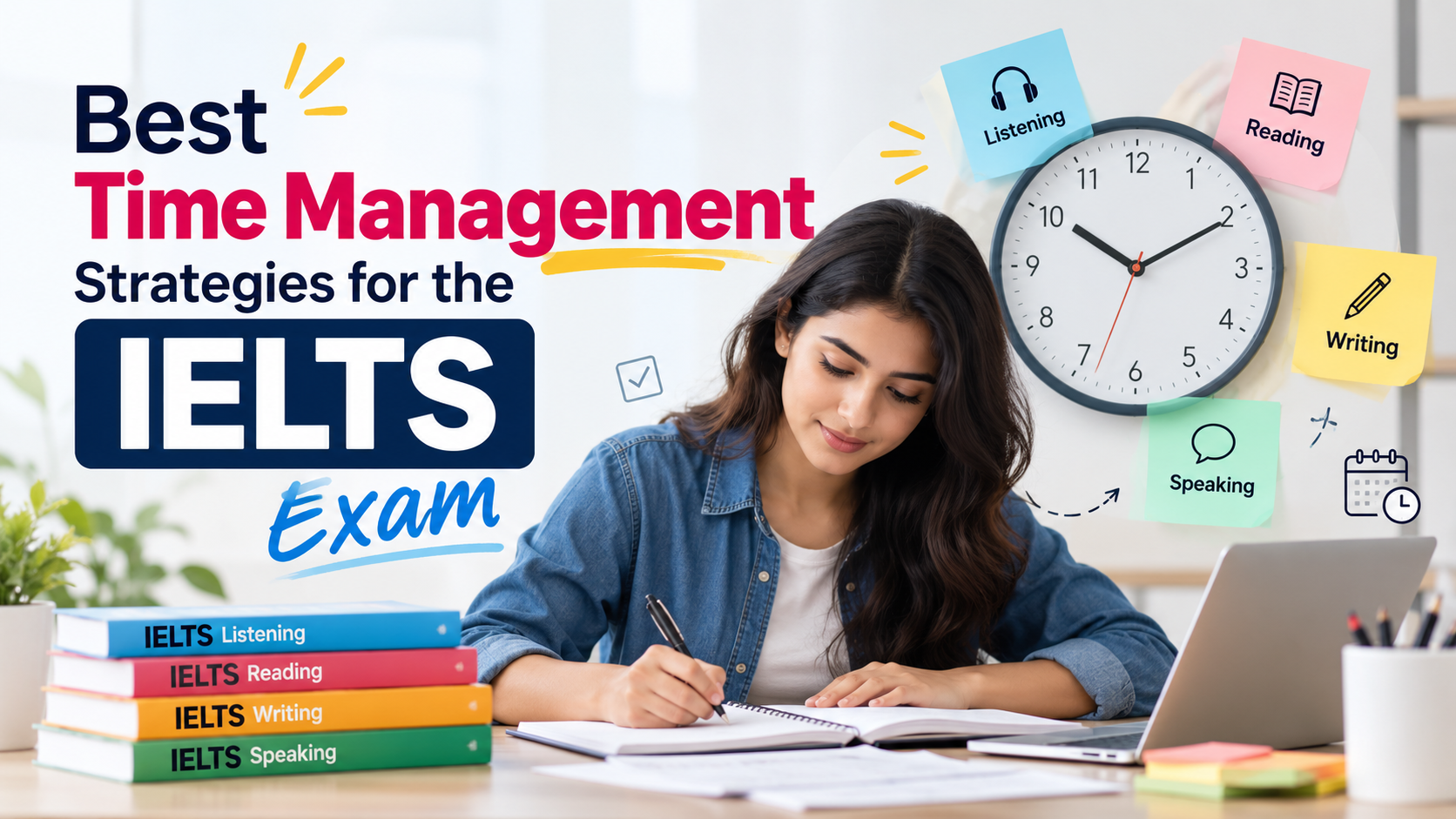
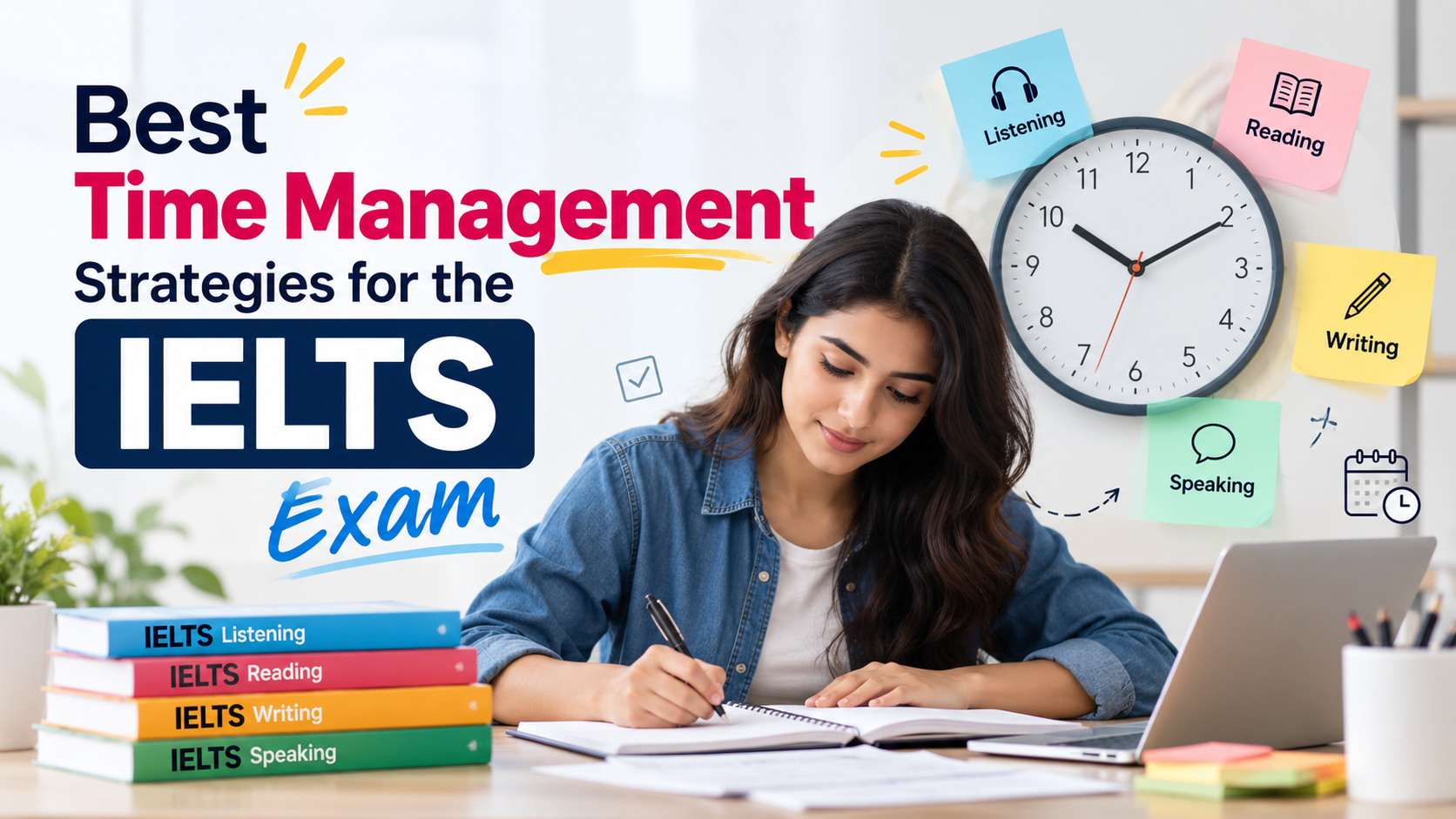
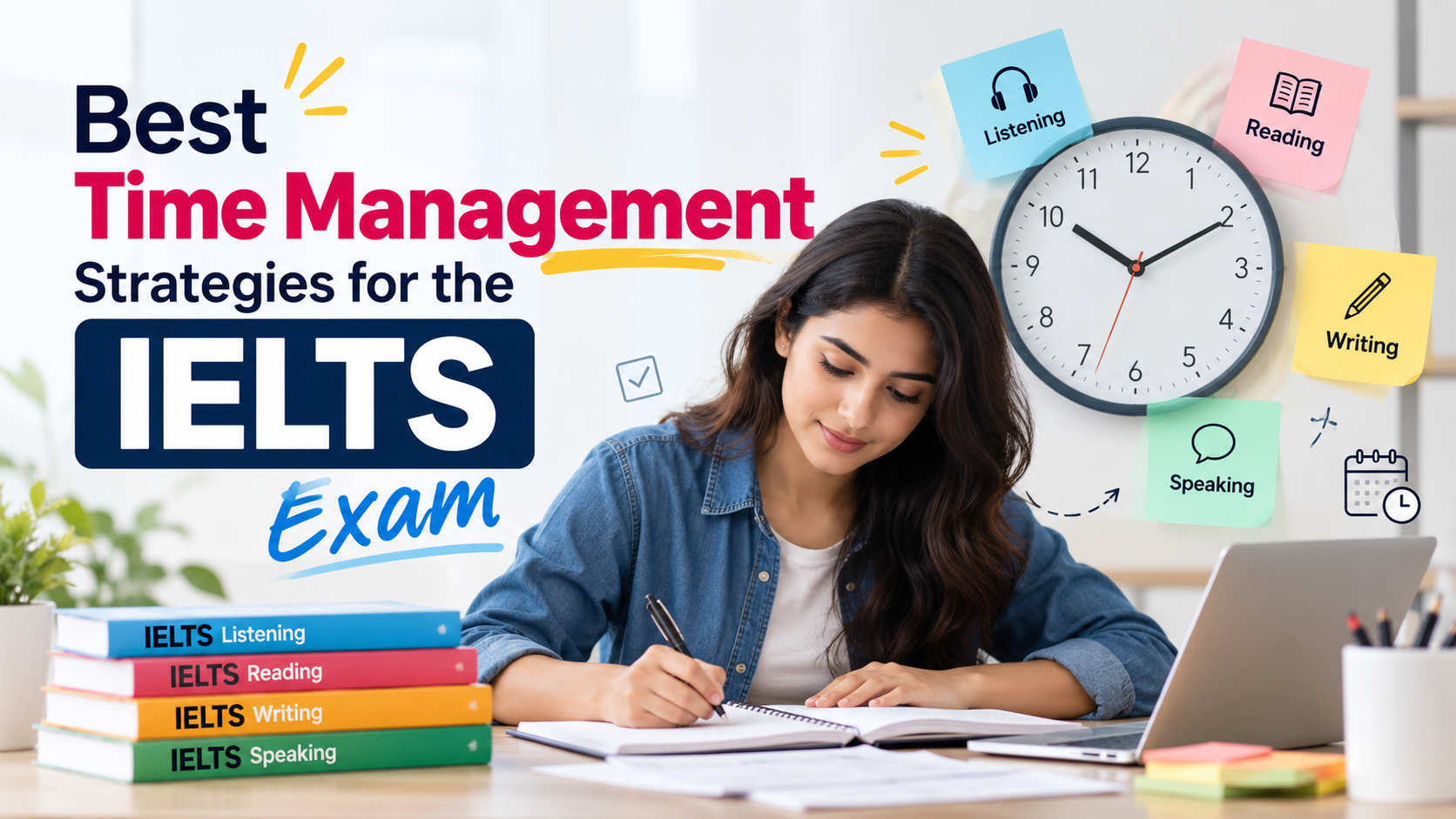
Best Time Management Strategies for the IELTS Exam

Preparing for the International English Language
Testing System (IELTS) exam requires more than strong English
language skills. Effective time management is equally important to help you
complete every section within the allotted time. Whether you are planning to
study abroad, pursue international career opportunities, or meet English
language requirements for migration, managing your time effectively can help
you approach the IELTS exam with greater confidence.
Many IELTS candidates struggle to finish the Reading and Writing
sections on time. Others spend too long on difficult Listening questions or
feel nervous during the Speaking test. The good news is that you can improve
your performance by practising with a structured study plan and learning how to
manage time during each section.
In this blog, we will explore practical IELTS time management
strategies to help you prepare efficiently and perform confidently on exam day.
Before developing a time management strategy, it is essential to
understand the IELTS exam format. The test assesses four English language
skills: Listening, Reading, Writing, and Speaking.
The IELTS Academic and General Training tests share the same Listening
and Speaking sections, while the Reading and Writing sections differ.
Here is a quick overview of the test duration:
|
IELTS Section |
Duration |
|
Listening |
Approximately 30 minutes |
|
Reading |
60 minutes |
|
Writing |
60 minutes |
|
Speaking |
11–14 minutes |
The Listening, Reading, and Writing sections are generally completed
on the same day. The Speaking test may take place on the same day or at a
separate time, depending on the test arrangements.
Understanding these time limits will help you plan your preparation
and develop a realistic approach to each section.
One of the most effective ways to manage your time is to create a
daily IELTS preparation timetable. Instead of studying randomly, divide your
available time between the four sections according to your strengths and
weaknesses.
For example, if you struggle with IELTS Reading, dedicate additional
practice time to reading comprehension, skimming, scanning, and
question-solving techniques.
Your timetable should include:
●
Listening practice using IELTS sample tests.
●
Reading exercises with a strict time limit.
●
Writing practice for Task 1 and Task 2.
●
Speaking practice with a partner or trainer.
●
Regular revision of vocabulary and grammar.
●
Weekly mock tests to evaluate your progress.
Tip: If you are working or studying, begin with 1–2 hours of focused IELTS
preparation daily. Consistency is more valuable than studying for long hours
without a clear plan.
The IELTS Listening test lasts approximately 30 minutes and includes
40 questions across four parts. You will hear each recording only once, so
staying focused is essential.
To manage your time effectively during IELTS Listening:
Use the available instructions and pauses to read the upcoming
questions. Identify keywords and predict the type of information required, such
as a name, date, number, or place.
Listen for the meaning rather than waiting for the exact words in the
question. Speakers may use synonyms or paraphrases.
If you miss an answer, move on to the next question. Spending too much
time thinking about a missed response may cause you to miss additional answers.
Use any available checking time to review spelling, grammar, and word
limits. For paper-based Listening tests, candidates generally receive an
additional 10 minutes to transfer answers to the answer sheet. Computer-based
tests have different answer-entry arrangements, so practise using the format
you have booked.
The IELTS Reading section is 60 minutes long and contains 40
questions. Completing all the questions within the time limit can be
challenging, especially when passages contain unfamiliar vocabulary or complex
information.
Use the following strategies to improve your reading speed and
accuracy.
For IELTS Academic Reading, a useful starting point is:
●
Passage 1: 15 minutes
●
Passage 2: 20 minutes
●
Passage 3: 25 minutes
This is a flexible practice plan, not a fixed exam requirement. Adjust
it according to your performance and the difficulty of each passage.
Skimming helps you understand the main idea of a passage quickly.
Scanning helps you locate specific information, such as names, dates, figures,
and keywords.
Practise both techniques regularly instead of reading every sentence
slowly.
If a question is taking too much time, make a note of it and move
forward where possible. Return to unanswered questions after completing the
easier ones.
Pay attention to word limits and the exact requirements of each
question. An answer that exceeds the stated word limit may be marked incorrect.
Practice tip: Complete timed IELTS Reading exercises and
review your mistakes afterwards. Identify whether you lost time because of slow
reading, unfamiliar vocabulary, or difficulty understanding question types.
The IELTS Writing test lasts 60 minutes and consists of two tasks.
Time management is especially important because both tasks must be completed
within the same hour.
For IELTS Academic Writing, Task 1 involves describing visual
information, while Task 2 requires an essay. General Training Task 1 involves
writing a letter.
A practical time allocation is:
●
Task 1: 20 minutes
●
Task 2: 40 minutes
Task 2 contributes twice as much as Task 1 to the Writing score,
making it important to reserve sufficient time for the essay.
Before writing, identify the main points you want to include. For an
essay, organise your ideas into an introduction, body paragraphs, and a
conclusion.
For Academic Task 1, identify the key trends, comparisons, or stages
that need to be described.
Write a clear and relevant introduction without spending too much time
searching for impressive vocabulary. Focus on answering the question directly.
Check your progress while writing. If you spend too long on one
paragraph, you may not have enough time to complete the remaining sections.
Keep the final 2–3 minutes for checking grammar, spelling,
punctuation, sentence structure, and whether you have answered the question.
The IELTS Speaking test lasts approximately 11–14 minutes and has
three parts. Although you do not need to manage a written paper, organising
your thoughts and answering naturally within the available time is essential.
You will answer questions about familiar topics, such as your
hometown, interests, studies, or work. Avoid giving only one-word answers, but
do not make every response unnecessarily long.
You will receive a topic card and have one minute to prepare. Use this
time to note down keywords and organise your ideas.
A simple structure is:
●
Introduce the topic.
●
Explain the main details.
●
Add a personal experience or example.
●
Conclude naturally.
Practise speaking for up to two minutes without memorising complete
answers.
This part involves a more detailed discussion. Give a clear opinion,
explain your reasoning, and support it with an example when appropriate.
Regular speaking practice will help you organise your thoughts more
quickly and reduce unnecessary pauses.
Mock tests are an essential part of effective IELTS preparation. They
help you become familiar with the exam format, practise under timed conditions,
and identify areas that need improvement.
Try to complete a full-length practice test regularly as your exam
date approaches.
During each mock test:
●
Follow the official time limits.
●
Avoid pausing the test unnecessarily.
●
Practise with the same test delivery format
you have booked.
●
Record the time taken for each section.
●
Review incorrect answers and unfinished tasks.
After the test, analyse your performance. If you consistently run out
of time in Reading, for example, focus on question-solving strategies and timed
passage practice in your next study sessions.
Not every IELTS candidate needs the same preparation schedule. Some
students may find Listening easy but struggle with Writing, while others may
need more practice with Reading comprehension.
Start by taking a diagnostic test to understand your current level.
Then allocate more preparation time to the skills that need improvement.
For example, if Writing is your weakest section, you could spend 40%
of your daily study time on Writing, 25% on Reading, 20% on Listening, and 15%
on Speaking.
These percentages are only a sample. Your study plan should reflect
your individual needs, target band score, and exam date.
Even well-prepared candidates can lose valuable time because of
avoidable mistakes.
Watch out for these common problems:
●
Spending too long on one question: Move
forward when necessary and return later if time permits.
●
Reading every passage word by word: Use
skimming and scanning to locate relevant information.
●
Writing without a plan: Spend a
few minutes organising your ideas before starting.
●
Memorising complete Speaking answers: Focus on
developing natural, flexible responses.
●
Ignoring timed practice: Practise
under realistic exam conditions rather than relying only on untimed exercises.
●
Leaving no time for checking: Reserve a
few minutes to review your answers whenever possible.
●
Studying without reviewing mistakes: Analyse
your performance to understand what needs improvement.
Avoiding these habits can help you use your preparation time more
effectively and feel better prepared for the actual test.
A structured weekly schedule can help you balance all four IELTS
skills without feeling overwhelmed.
|
Day |
IELTS Preparation
Activity |
|
Monday |
Listening practice and vocabulary |
|
Tuesday |
Reading passages and timed exercises |
|
Wednesday |
Writing Task 1 practice |
|
Thursday |
Writing Task 2 practice |
|
Friday |
Speaking practice and pronunciation |
|
Saturday |
Full-length or section-based mock test |
|
Sunday |
Review mistakes and revise weak areas |
You can adjust this schedule based on your availability. Students with
limited preparation time can combine two skills in one session or focus on
shorter, targeted exercises.
The key is to maintain a consistent routine and track your progress.
Good time management also depends on maintaining concentration.
Feeling nervous can make it difficult to understand questions, organise ideas,
or make decisions quickly.
To prepare for exam day:
●
Get sufficient sleep the night before.
●
Arrive at the test centre early, if taking the
test in person.
●
Read all instructions carefully.
●
Keep track of the time without checking the
clock excessively.
●
Focus on the question in front of you rather
than worrying about previous answers.
●
Follow the timing and answer-entry rules for
your chosen test format.
Remember that the goal is not simply to finish quickly. It is to use
the available time effectively while providing accurate, relevant, and
well-organised answers.
Effective time management is an important part of IELTS
preparation. By creating a realistic study timetable,
practising with timed exercises, understanding the format of each section, and
taking regular mock tests, you can develop the skills needed to manage the exam
confidently.
Start by identifying your weak areas and setting achievable daily
goals. Practise consistently, review your mistakes, and gradually increase the
amount of timed practice as your exam date approaches.
If you are planning to study abroad and need guidance with IELTS
preparation and your international education journey, ONT Global can
help you explore your options and take the next step towards your academic
goals.
Visit ONT Global to learn more
about study abroad opportunities and get started on your journey.