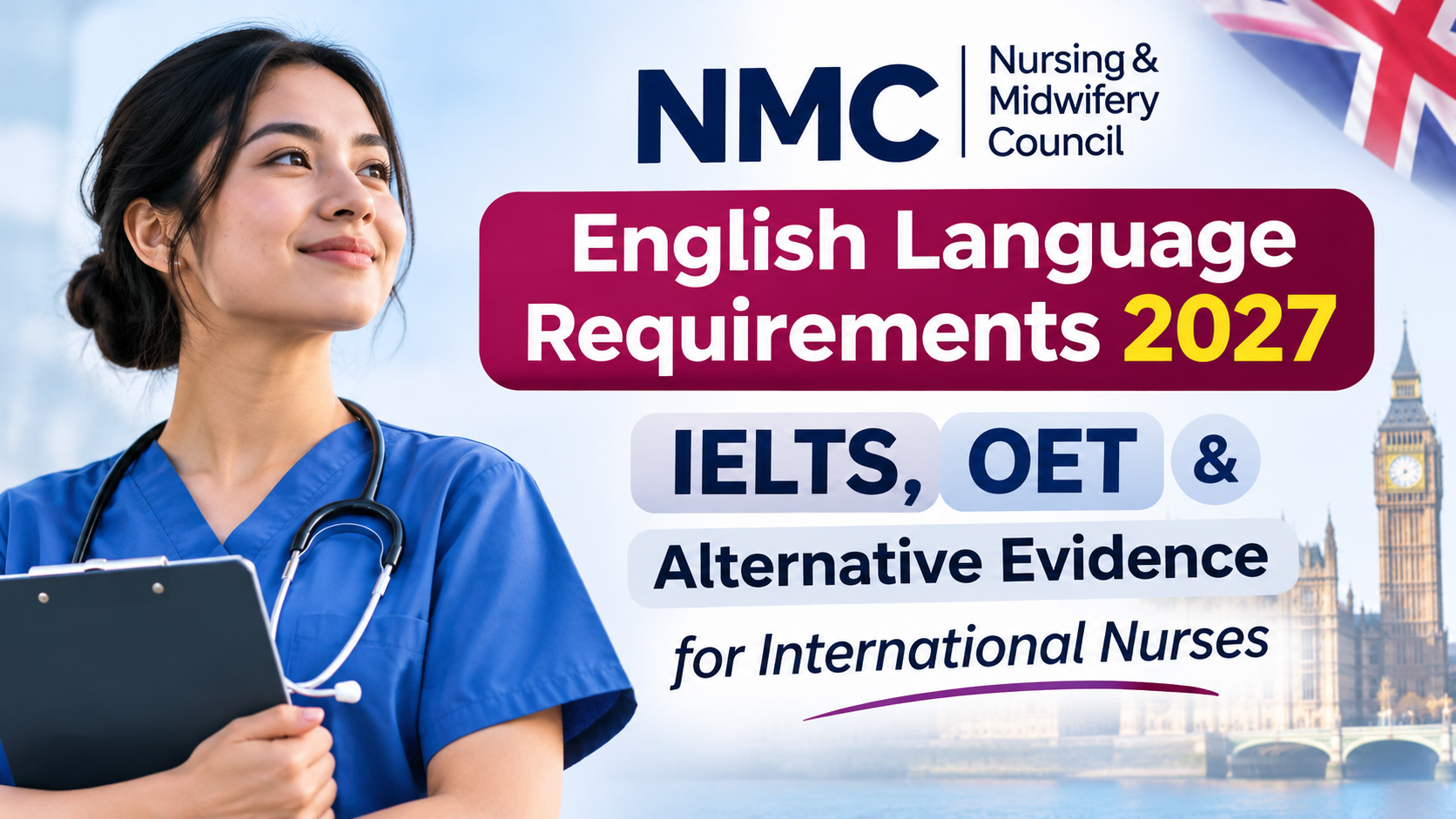
NMC English Language Requirements 2027: IELTS, OET and Alternative Evidence for International Nurses

Planning to work as a registered nurse in the United Kingdom in 2027?
Meeting the Nursing and Midwifery Council (NMC) English language requirements
is an important part of your UK nursing registration journey.
International nurses must demonstrate that they can communicate
effectively in English to provide safe and professional patient care. Whether
you are applying from India, the Philippines, Nigeria, the Middle East or
another country, understanding the accepted English language evidence can help
you prepare your NMC application more confidently.
The good news is that taking an English language test is not the only
possible route. The NMC recognises IELTS Academic and the Occupational English
Test (OET), but eligible applicants may also demonstrate their English
proficiency through an English-taught nursing qualification or recent
professional practice in a majority English-speaking country. Certain
applicants may also use Supporting Information from Employers (SIFE) as
supplementary evidence.
In this guide, ONT Global explains the NMC English language
requirements for 2027, including IELTS and OET scores, alternative evidence
options, test validity, score combining and practical preparation tips for
international nurses.
Important update: This article reflects the NMC guidance
available as of November 2026. The requirements below should not be interpreted
as newly announced 2027 changes. Always check the official NMC website before
submitting your application.
The NMC requires nurses, midwives and nursing associates applying to
join its register to demonstrate sufficient English language proficiency to
practise safely and effectively in the UK.
Applicants must demonstrate competence in four essential language
skills:
●
Reading
●
Writing
●
Listening
●
Speaking
These skills are important in everyday nursing responsibilities,
including understanding medical instructions, communicating with patients,
explaining treatments, maintaining accurate clinical records and participating
in multidisciplinary healthcare discussions.
The NMC currently recognises three main types of English language
evidence:
Some eligible applicants may also use Supporting Information from
Employers (SIFE) alongside other acceptable evidence.
Choosing the right route depends on your education, professional
experience and individual circumstances.
The International English Language Testing System (IELTS) Academic is
one of the English language examinations accepted by the NMC.
It assesses your ability to understand and communicate in English
across academic and professional contexts. For internationally educated nurses,
IELTS Academic can be used to demonstrate the English proficiency required for
UK nursing registration.
Under the current NMC requirements, applicants must achieve the
following minimum scores:
|
IELTS Academic
Component |
Required Score |
|
Listening |
7.0 |
|
Reading |
7.0 |
|
Writing |
6.5 |
|
Speaking |
7.0 |
One important point is that the NMC assesses individual component
scores rather than relying only on your overall IELTS band.
For example, even if your overall IELTS score is 7.5, a writing score
below 6.5 would not meet the standard through a single test sitting.
Yes. The NMC allows eligible applicants to combine results from two
IELTS test sittings.
You must satisfy the following conditions:
●
Both tests must be taken within 12 months of
each other.
●
Both test results must be no more than two
years old when the NMC assesses your complete application.
●
You must be assessed in all four language
skills in both sittings.
●
You must achieve the required score in each
skill across the two tests.
●
Neither test can fall below the NMC's minimum
permitted scores for the relevant components.
For IELTS, the minimum scores across the two sittings are:
|
Component |
Minimum Score |
|
Listening |
6.5 |
|
Reading |
6.5 |
|
Writing |
6.0 |
|
Speaking |
6.5 |
For instance, if you achieve the required listening, reading and
speaking scores in your first examination but narrowly miss the writing
requirement, you may be able to meet the requirements using a second eligible
IELTS result.
However, the NMC's score-combining rules must be followed carefully.
Applicants should use the official NMC test-combining calculator before relying
on two results.
The Occupational English Test (OET) is another popular option for
internationally educated nurses.
Unlike IELTS Academic, OET focuses on healthcare-related
communication. Its examination tasks are designed around situations that
healthcare professionals may encounter in their working environments.
For nurses, this can include communicating with patients,
understanding clinical information, writing referral letters and discussing
patient care with other healthcare professionals.
The current NMC minimum OET scores are:
|
OET Component |
Required Grade |
Minimum Score |
|
Listening |
B |
350 |
|
Reading |
B |
350 |
|
Writing |
C+ |
300 |
|
Speaking |
B |
350 |
Candidates must meet the required score in all four components.
For nurses who are more comfortable with healthcare-related English,
OET may be a suitable option. However, the examination still requires
preparation, particularly in writing and speaking.
Yes. The NMC permits eligible applicants to combine two OET test
sittings, subject to specific conditions.
These include:
●
Both examinations must take place within 12
months of each other.
●
Both results must be within the NMC's two-year
validity period when the complete application is assessed.
●
All four language skills must be tested in
both sittings.
●
The required scores must be achieved across
the two examinations.
●
Neither examination can fall below the NMC's
minimum permitted scores.
The current minimum scores for combining OET results are:
|
Component |
Minimum Score |
|
Listening |
300 |
|
Reading |
300 |
|
Writing |
250 |
|
Speaking |
300 |
Remember that IELTS and OET results cannot be combined with each
other. You must use two IELTS sittings or two OET sittings.
One of the most common questions among internationally educated nurses
is whether they should choose IELTS or OET.
Both examinations are accepted by the NMC, but their formats and
assessment approaches are different.
|
Feature |
IELTS Academic |
OET |
|
Main focus |
Academic English |
Healthcare English |
|
Listening |
General and academic contexts |
Healthcare-related contexts |
|
Reading |
Academic texts |
Healthcare-related texts |
|
Writing |
Academic writing tasks |
Profession-specific writing tasks |
|
Speaking |
General interview format |
Healthcare role-play scenarios |
|
NMC acceptance |
Yes |
Yes |
IELTS Academic may be suitable if:
●
You are comfortable with academic English.
●
You have experience with essay writing and
structured reading tasks.
●
You prefer a widely recognised English
language examination.
●
You have already prepared for IELTS and
understand its examination format.
OET may be suitable if:
●
You are comfortable with healthcare
terminology.
●
You regularly communicate with patients and
healthcare professionals.
●
You prefer profession-specific speaking and
writing tasks.
●
You want to practise English in clinical
situations.
Neither examination is automatically easier. Your performance will
depend on your language skills, preparation and familiarity with the test
format.
Before booking, review the latest NMC requirements and choose the
examination that matches your strengths.
Not every international nurse needs to demonstrate English proficiency
through IELTS or OET.
The NMC recognises alternative evidence routes for applicants who meet
specific eligibility criteria.
These options can be particularly useful for nurses who completed
their education in English or have relevant professional experience in an
English-speaking country.
If you completed a pre-registration nursing qualification that was
both taught and examined in English, you may be able to use this qualification
as evidence of your English language proficiency.
This route may be suitable for nurses who completed their nursing
education in countries where English is not the majority-spoken language.
For example, an internationally educated nurse who completed a nursing
degree in India may be able to explore this route if the programme meets the
NMC's specific requirements.
However, simply studying in an institution where English is used as a
medium of instruction does not automatically guarantee acceptance.
The NMC may require supporting documentation from your educational
institution confirming:
●
The language used to teach the nursing
programme.
●
The language used to assess and examine
students.
●
The details of the pre-registration nursing
qualification.
●
Other information required to verify the
programme.
Applicants should review the NMC's evidence requirements before
choosing this option.
Another alternative is demonstrating English proficiency through
recent professional practice.
The NMC may accept evidence if you have completed at least one year of
recent practice as a nurse, midwife or nursing associate in a country where
English is the majority-spoken language.
This option may be relevant to nurses who have already worked in
countries such as the United Kingdom, Ireland, Australia or other qualifying
English-majority-speaking countries.
You may need to provide supporting employment documentation, such as:
●
Employer references.
●
Employment verification letters.
●
Details of your professional role.
●
Confirmation of your employment period.
●
Evidence of the country where you practised.
The NMC will assess whether your professional experience meets its
criteria. Working in an English-speaking healthcare environment alone does not
automatically qualify you for this route.
Supporting Information from Employers (SIFE) is another option that
some internationally educated nurses may be able to use as part of their NMC
English language evidence.
SIFE is particularly relevant to certain applicants who have completed
their nursing education in English or who have narrowly missed the required
IELTS or OET scores.
However, it is important to understand that SIFE is not a standalone
English language qualification.
It is supplementary evidence that must be used alongside other
qualifying forms of English language evidence.
Under the current NMC guidance, applicants may be eligible if they:
●
Completed a pre-registration nursing programme
taught and examined in English in a country where English is not the
majority-spoken language; or
●
Have attempted an accepted English language
test twice and narrowly missed the required score in one or more components by
no more than 0.5 IELTS band or half an OET grade.
Applicants must also satisfy specific employment conditions.
These include:
The employer must have observed the applicant's English communication
skills in a real healthcare environment.
The process generally involves:
The NMC will assess the submitted evidence as part of your
application.
SIFE is not guaranteed approval, and employers are not obliged to
provide it even when an applicant meets the eligibility criteria.
For complete information, refer to the official NMC SIFE guidance.
The NMC currently accepts IELTS and OET results that are no more than
two years old when it assesses your complete application.
This is an important detail for nurses planning their UK registration
well in advance.
For example, if you take IELTS in January 2027 but your complete
application is not assessed until February 2029, your result may no longer
satisfy the validity requirement.
If you are combining two test results, both examinations must satisfy
the applicable validity conditions.
●
Check your examination dates before starting
your registration application.
●
Do not rely only on the certificate issue
date.
●
Plan your English examination alongside your
CBT and registration preparation.
●
Ensure the NMC can verify your results.
●
If you are using OET, provide the necessary
permission for verification through your myOET account.
Planning your examination at the right time can help prevent
unnecessary delays in your registration journey.
Many nurses spend considerable time preparing for IELTS or OET but
still experience difficulties meeting the NMC requirements.
Here are some common mistakes to avoid.
The NMC requires specific scores in all four language components. An
impressive overall score does not compensate for an insufficient individual
component score.
Some candidates book IELTS General Training instead of IELTS Academic.
The NMC accepts IELTS Academic, not IELTS General Training.
Always verify the accepted examination before booking.
Taking your examination too early can create problems if your results
expire before the NMC assesses your complete application.
Although two test results can be combined, the NMC has minimum score
requirements, time limits and other conditions.
Do not assume that any two results can automatically be combined.
SIFE has specific educational, examination and UK employment
eligibility requirements. It is not a general exemption from IELTS or OET.
English communication is essential beyond the examination room. Nurses
should also develop confidence in patient communication, clinical handovers,
documentation and professional discussions.
A structured preparation plan can help you approach your English
language examination with greater confidence.
Here are some practical preparation recommendations.
Step 1: Assess your current English proficiency
Identify your strengths and weaknesses in listening, reading, writing
and speaking. A diagnostic assessment can help you understand which components
require more attention.
Step 2: Choose IELTS Academic or OET
Select the examination based on your language abilities, professional
background and familiarity with the test format.
Step 3: Follow a structured study timetable
Allocate regular study time to all four components. Avoid
concentrating only on the areas you already perform well in.
Step 4: Practise healthcare communication
For nurses, clinical communication is especially important. Practise
explaining medical procedures, communicating with patients, taking patient
histories and discussing care plans.
Step 5: Complete mock examinations
Mock tests help you understand examination timing, question formats
and areas where you need improvement.
Step 6: Review your scores before booking again
If you do not achieve the required score, analyse your performance
before scheduling another test. This can help you avoid repeating the same
mistakes.
Preparing for a UK nursing career involves
more than meeting the English language requirements. International nurses must
also understand the NMC registration process, complete applicable competency
assessments and prepare for employment opportunities.
ONT Global supports aspiring international nurses through a range of
services designed to help them progress towards their overseas nursing careers.
Our services include:
●
IELTS Preparation: Structured
preparation to improve academic English language skills and examination
performance.
●
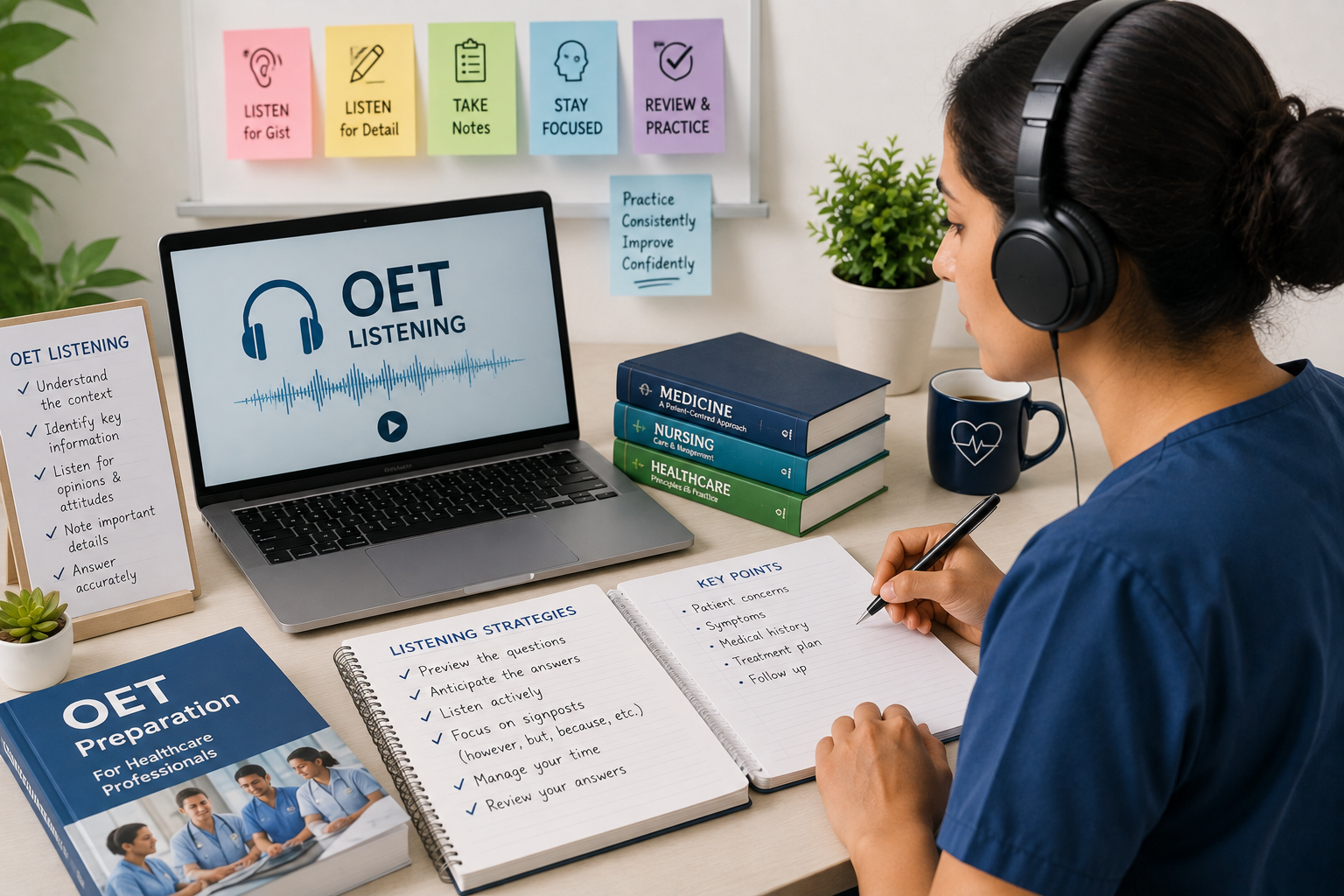
OET Training:
Healthcare-focused English preparation for nurses and other healthcare
professionals.
●
NMC
CBT Preparation: Support to prepare for the
Computer-Based Test.
●
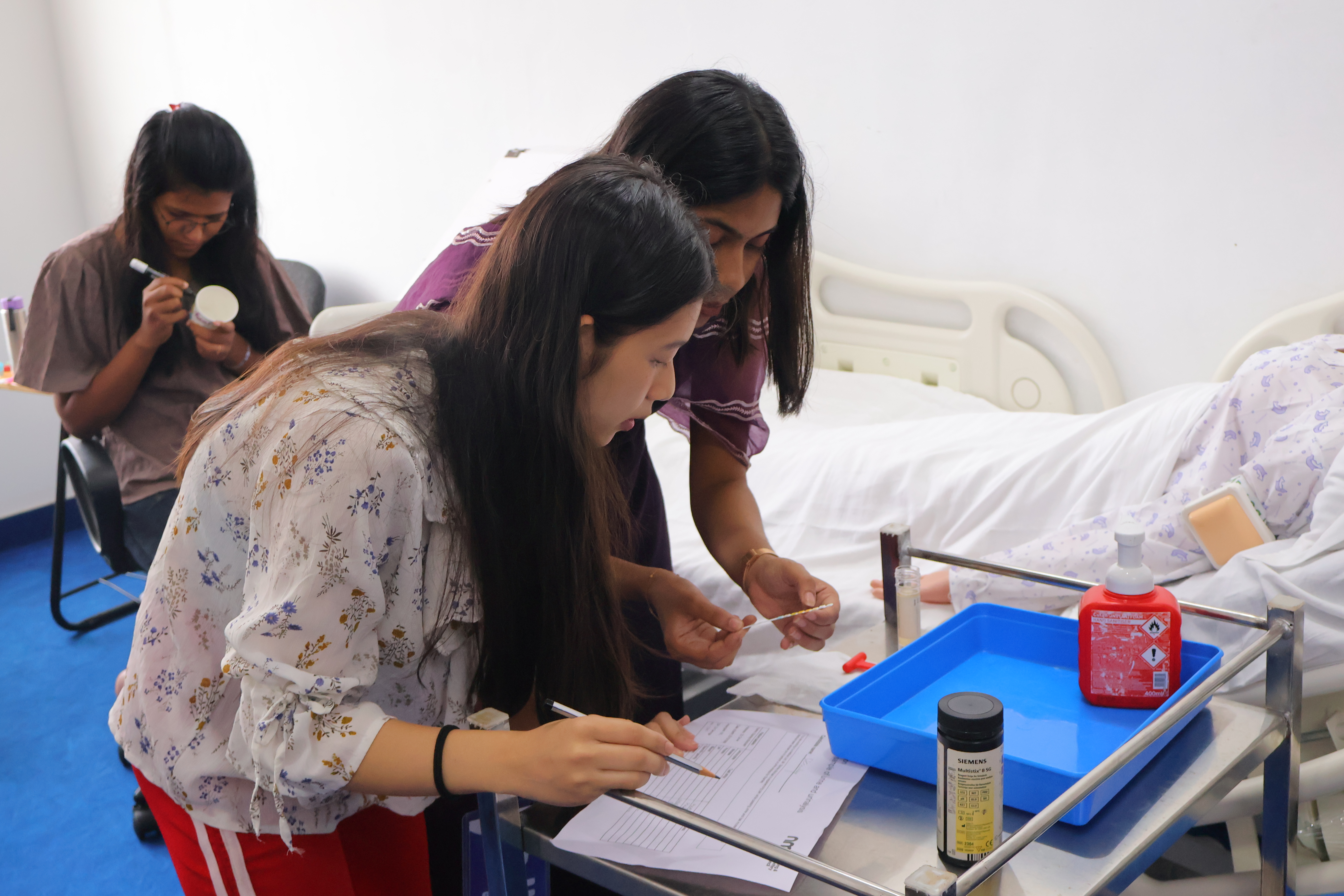
OSCE Training: Practical
preparation for the Objective Structured Clinical Examination.
●
UK
Nursing Placements: Guidance and
support for eligible candidates exploring UK nursing employment opportunities.
Whether you are beginning your IELTS or OET preparation or progressing
through your NMC registration journey, having the right guidance can make the
process more organised.
Explore ONT Global's IELTS and OET training programmes and take
the next step towards your UK nursing career.
Meeting the NMC English language requirements is an important
milestone for international nurses planning to work in the UK in 2027.
Whether you choose IELTS Academic, OET or an eligible alternative
evidence route, understanding the requirements early can help you avoid
unnecessary delays and prepare your registration documents correctly.
Remember that the NMC assesses English language proficiency to ensure
nurses can communicate effectively and provide safe patient care. Therefore,
your preparation should focus not only on examination scores but also on
practical healthcare communication.
Start preparing today, explore the evidence route that suits your
circumstances and take a confident step towards your UK nursing career with ONT
Global.
Ready to prepare for your UK nursing journey? Contact ONT Global
to explore our IELTS, OET, CBT and OSCE training programmes.