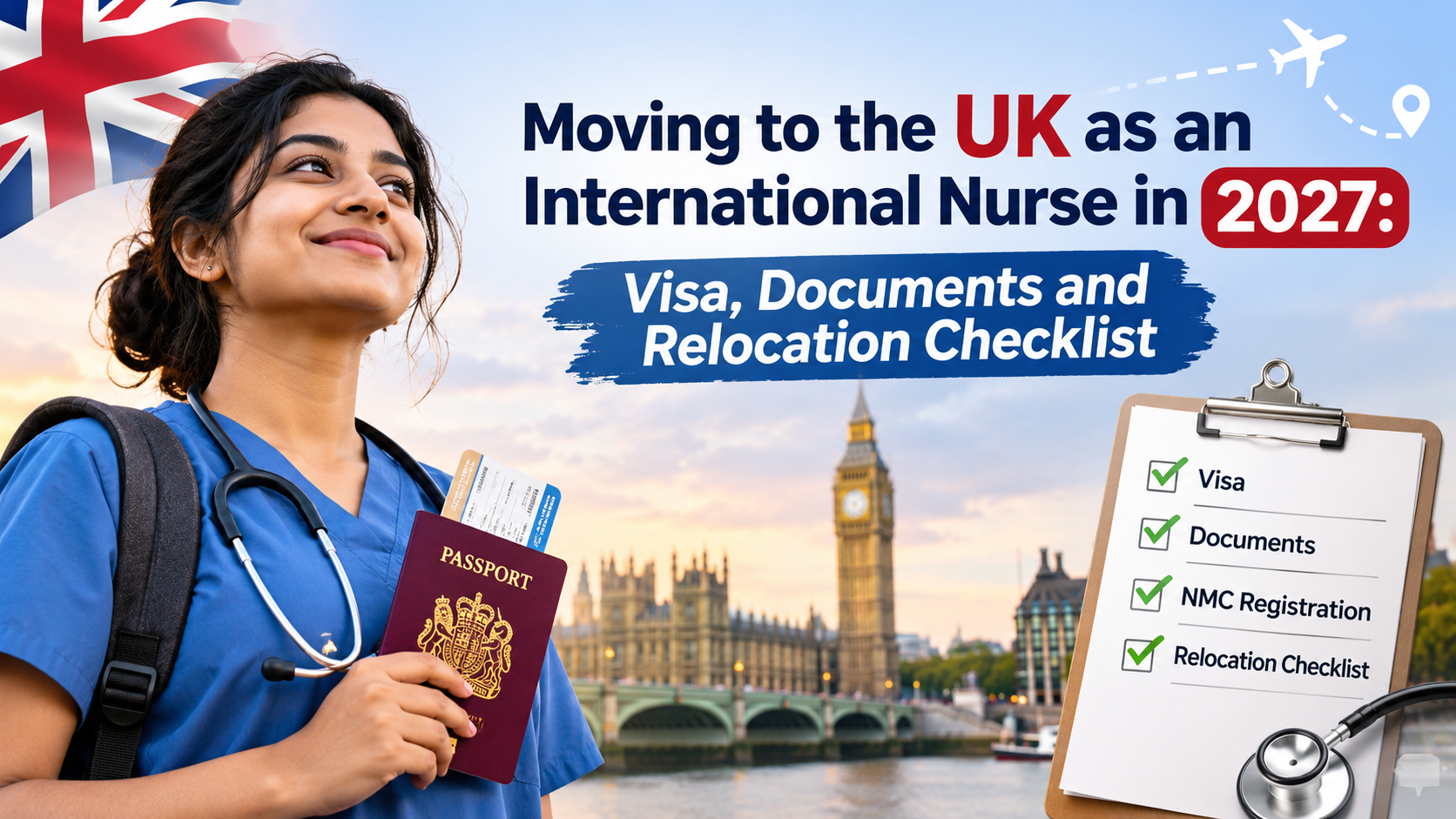
UK Health and Care Worker Visa 2027: Salary, Eligibility, Dependants and Application Process for Nurses

The United Kingdom continues to be an attractive destination for
internationally educated nurses looking to develop their careers in a
well-established healthcare system. With opportunities across NHS hospitals,
private healthcare organisations and specialist medical facilities, the UK
offers international nurses the chance to gain valuable clinical experience
while building a long-term professional future.
For nurses planning to relocate in 2027, understanding the UK
Health and Care Worker Visa is an important part of the journey. This visa
route allows eligible healthcare professionals, including registered nurses, to
work for approved UK healthcare employers.
However, securing a UK nursing job involves
more than receiving an employment offer. International applicants must
understand the visa eligibility criteria, salary requirements, Nursing and
Midwifery Council (NMC) registration process, English language requirements and
documentation needed for their application.
Another important consideration is whether nurses can bring their
spouse and children to the UK as dependants.
In this guide, ONT Global explains the key aspects of the UK Health
and Care Worker Visa 2027, helping international nurses understand the
requirements and prepare for their UK nursing career.
The Health and Care Worker Visa is a dedicated immigration route
within the UK's Skilled Worker visa system. It allows eligible healthcare
professionals to come to the UK or remain in the country to work for approved
healthcare employers.
The visa is particularly relevant to internationally qualified nurses
who have secured employment with an eligible NHS organisation, NHS supplier or
another qualifying healthcare employer.
Registered nurses are among the healthcare professionals eligible for
this route, provided they meet the relevant occupation, sponsorship, salary and
other immigration requirements.
International nurses applying through this route may benefit from:
●
The opportunity to work legally for an
approved UK healthcare employer.
●
Reduced visa application fees compared with
the standard Skilled Worker route.
●
Exemption from the Immigration Health
Surcharge for eligible applicants and dependants.
●
The possibility of bringing eligible family
members to the UK.
●
Permission to stay for up to five years,
depending on the sponsorship period.
●
The possibility of applying for settlement
after meeting the applicable qualifying requirements.
The visa can be extended if the applicant continues to meet the
relevant immigration requirements.
Important: The Health and Care Worker Visa is different
from general care worker recruitment. Registered nurses and adult social care
workers are subject to different occupation and eligibility rules.
To qualify for a Health and Care Worker Visa, international nurses
must satisfy several requirements.
Applicants should hold an appropriate nursing qualification from a
recognised educational institution in their home country.
For overseas nurses, the UK Nursing and Midwifery Council (NMC)
assesses qualifications and professional eligibility as part of its
international registration process.
Nurses intending to practise in the UK must obtain the appropriate NMC
registration.
The international registration process generally involves:
●
Completing the NMC eligibility and
qualification assessment.
●
Providing the required identity and
qualification documents.
●
Meeting the NMC English language requirements.
●
Completing the Test of Competence, where
applicable.
●
Satisfying the remaining registration
requirements.
The Test of Competence includes the Computer-Based Test (CBT) and
Objective Structured Clinical Examination (OSCE), where required.
Applicants should check their individual eligibility and the latest
NMC registration guidance before starting the process.
A confirmed job offer from an approved UK sponsor is essential.
Eligible employers may include:
●
NHS hospitals and trusts.
●
NHS-approved healthcare organisations.
●
Eligible private healthcare providers.
●
Other healthcare organisations meeting the
relevant sponsorship conditions.
Applicants should verify that their prospective employer holds a valid
Home Office sponsor licence and can issue a Certificate of Sponsorship (CoS).
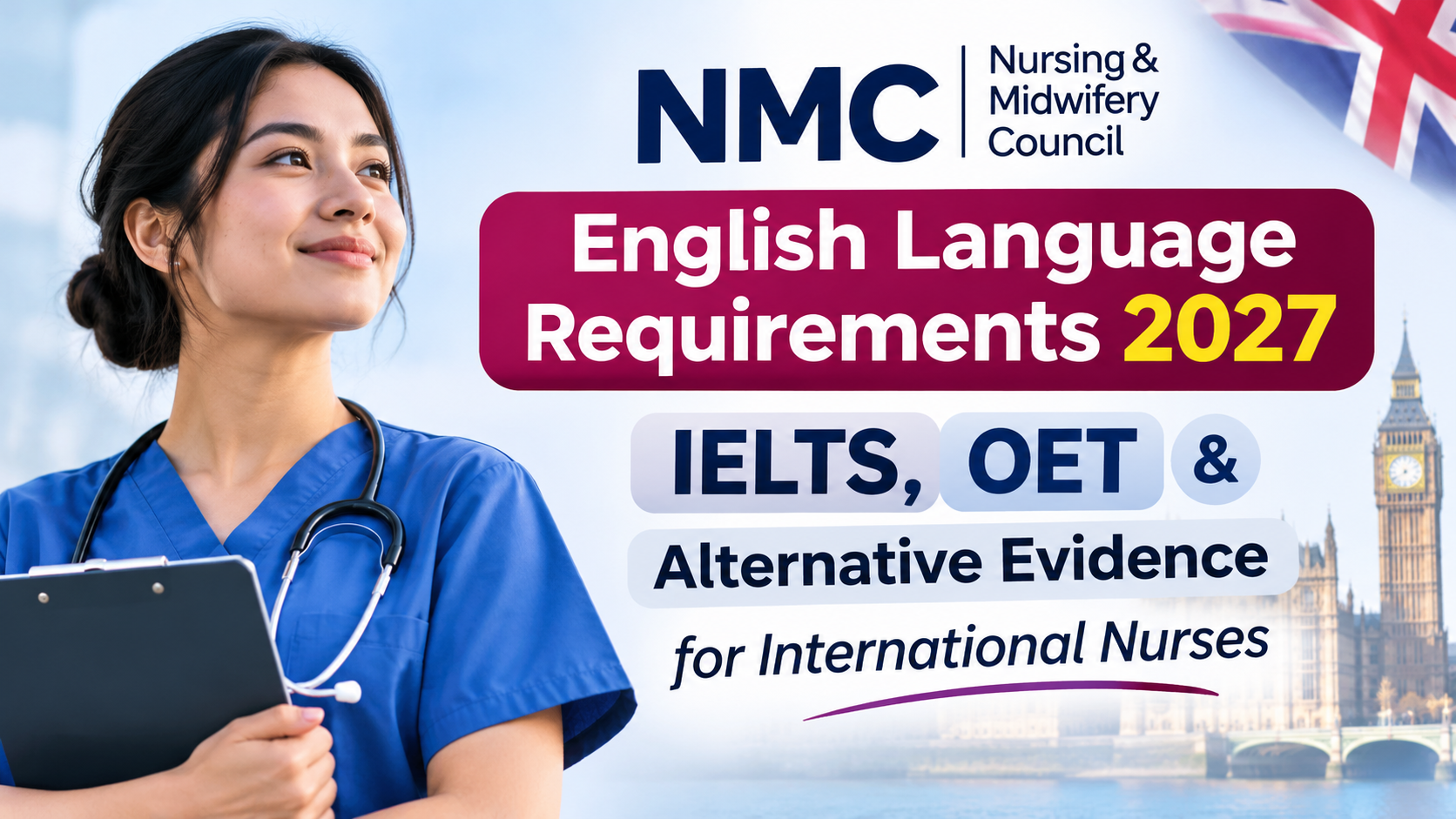
International nurses must demonstrate the required level of English
for professional registration and immigration purposes.
The NMC accepts specific English language evidence, including IELTS
Academic and OET, subject to its score and test-combination rules.
The current NMC requirements include:
|
English test |
Listening |
Reading |
Writing |
Speaking |
|
IELTS Academic |
7.0 |
7.0 |
6.5 |
7.0 |
|
OET |
B (350) |
B (350) |
C+ (300) |
B (350) |
The NMC also has provisions for combining results from two test
sittings, subject to specific conditions.
For immigration purposes, new Health and Care Worker Visa applicants
are generally subject to the English language standard of CEFR B2. However,
nurses who have passed an English language assessment accepted by their
relevant professional regulator may not need to provide separate English
evidence for their visa application.
It is important to understand that NMC professional registration
requirements and UK immigration English requirements are related but not
identical. Applicants should confirm that their evidence satisfies both
applicable processes.
Salary is one of the most important factors when applying for a UK
Health and Care Worker Visa.
Unlike some other Skilled Worker occupations, eligible nursing roles
are generally assessed using the relevant UK national healthcare pay scales.
The salary requirement depends on:
●
The nursing occupation code.
●
The NHS pay band or equivalent salary scale.
●
The country where the applicant will work.
●
The contracted working hours.
●
The applicable immigration salary rules.
Many registered nursing positions are paid under the NHS Agenda for
Change pay structure.
The NHS uses different pay bands depending on the nurse's role,
responsibilities, experience and specialist qualifications.
Examples include:
|
NHS Band |
Typical nursing
roles |
|
Band 5 |
Staff nurses and newly registered nurses |
|
Band 6 |
Senior staff nurses and specialist nurses |
|
Band 7 |
Advanced specialist and senior nursing positions |
|
Band 8 |
Senior management and advanced leadership roles |
For eligible healthcare occupations paid under national pay scales,
the immigration salary assessment uses the applicable occupation-specific pay
scale and relevant minimum salary requirements.
The published Home Office healthcare salary table updated in July 2025
listed the following Band 5 annual salary figures:
|
UK region |
Published Band 5
figure |
|
England |
£29,970 |
|
Scotland |
£31,892 |
|
Wales |
£30,420 |
|
Northern Ireland |
£28,407 |
These are reference figures from the published 2025 salary table, not
guaranteed 2027 salaries. NHS pay awards and Home Office salary tables can
change, so applicants must check the latest figures applicable when their
Certificate of Sponsorship is issued.
Not necessarily. Salary depends on the actual job, pay band,
responsibilities and employer's pay structure.
For example, a registered nurse recruited into a Band 5 position may
have a different starting salary from a specialist nurse employed at Band 6 or
Band 7.
Important salary advice: Before accepting a UK nursing job
offer, confirm the annual salary, contracted weekly hours, NHS band, occupation
code and whether the proposed salary meets the relevant Home Office
requirements.
Yes. Eligible nurses applying through the Health and Care Worker route
can generally bring their qualifying family members to the UK as dependants.
This is an important advantage for internationally qualified nurses
planning to relocate with their families.
Unlike the restrictions affecting certain care worker and senior care
worker occupations, the dependant restrictions introduced for those roles do
not generally prevent eligible registered nurses from sponsoring their
qualifying family members.
The following family members may qualify:
1. Husband, wife or civil partner
A legally recognised spouse or civil partner can apply as a dependant.
2. Unmarried partner
An unmarried partner may qualify if the relationship meets the Home
Office requirements, generally involving at least two years in a relationship,
with appropriate evidence.
3. Children under 18
Dependent children under 18 may apply to accompany their parent to the
UK.
4. Children over 18
Children over 18 may qualify if they already have permission to stay
in the UK as the main applicant's dependant and satisfy the relevant
conditions.
Family members must generally demonstrate that sufficient funds are
available to support them in the UK.
The currently published maintenance requirements are:
|
Family member |
Required
maintenance funds |
|
Main applicant |
£1,270 |
|
Spouse or partner |
£285 |
|
First child |
£315 |
|
Each additional child |
£200 |
For example, a nurse travelling with a spouse and one child may need
to demonstrate:
●
Main applicant: £1,270
●
Spouse: £285
●
One child: £315
●
Total: £1,870
These funds must generally be held for at least 28 consecutive days,
with the final day falling within 31 days of the visa application.
There are exemptions, including where the sponsor certifies
maintenance on the Certificate of Sponsorship or the relevant applicant meets
the qualifying previous UK residence conditions.
Generally, yes. An eligible dependant partner can work in the UK,
including in full-time or part-time employment, subject to the conditions
attached to their immigration permission.
They can also study in the UK.
However, dependant permission does not automatically provide
professional registration for regulated occupations.
One of the major advantages of the Health and Care Worker Visa is its
reduced application fee compared with the standard Skilled Worker route.
The currently published standard application fees are:
|
Visa duration |
Application fee
per applicant |
|
Up to 3 years |
£324 |
|
More than 3 years |
£628 |
These fees apply to the main applicant and each dependant, where
applicable.
Eligible Health and Care Worker Visa applicants and their dependants
are exempt from paying the Immigration Health Surcharge (IHS).
This can significantly reduce the overall cost of relocating to the
UK.
Applicants should still budget for other expenses, including:
●
English language examinations, if required.
●
NMC registration and examination fees.
●
Document verification and translation.
●
Travel expenses.
●
Accommodation and initial living costs.
●
Visa application centre services, where
applicable.
Visa fees may change before 2027. Always check the official UK
Government fee schedule before submitting an application.
Preparing the correct documentation can help avoid unnecessary delays
in the visa application process.
International nurses should generally prepare the following documents:
●
Valid passport or travel document.
●
Recent passport photographs, if required.
●
Personal identification documents.
●
Previous immigration details, where
applicable.
●
Nursing degree or diploma certificates.
●
Nursing registration and licence from the home
country.
●
NMC registration or relevant registration
evidence.
●
IELTS or OET results, where applicable.
●
CBT and OSCE evidence, where applicable.
●
Employment experience certificates, if
requested.
●
Certificate of Sponsorship reference number.
●
UK employer and job details.
●
Occupation code.
●
Annual salary and contracted working hours.
●
Job title and employment information.
●
Bank statements, where maintenance evidence is
required.
●
Evidence of qualifying funds held for the
required period.
●
Sponsor maintenance confirmation, if
applicable.
For applicants bringing dependants, additional documents may include:
●
Marriage certificate.
●
Birth certificates of children.
●
Evidence of an unmarried partnership.
●
Proof of relationship and dependency.
●
Financial maintenance evidence, where
required.
The exact document checklist depends on the applicant's circumstances
and the information requested during the online application.
The UK visa application process involves several stages, beginning
with professional eligibility and ending with travel to the UK.
Here is a simplified overview for international nurses.
Start by understanding the NMC registration requirements for
internationally educated nurses.
Check your nursing qualification, registration history and eligibility
through the NMC's official website.
Prepare for IELTS Academic or OET if you need to demonstrate your
English language ability for NMC registration.
Achieving the required scores can help you progress through the
professional registration process.
Where applicable, pass both components of the NMC Test of Competence:
●
CBT: Computer-Based Test.
●
OSCE: Objective Structured Clinical
Examination.
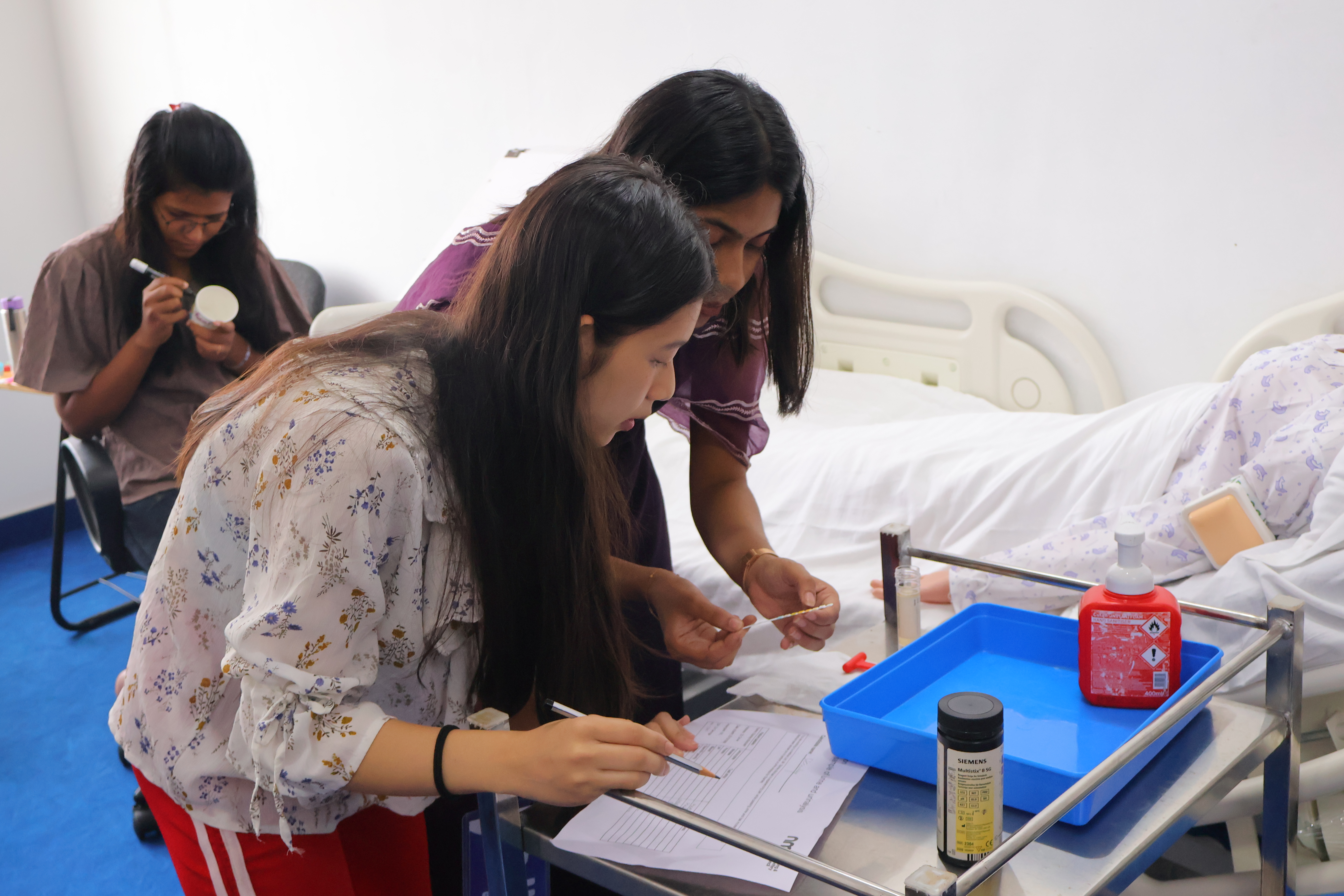
The OSCE is generally completed in the UK at an approved examination
centre as part of the international registration process.
Complete the remaining registration requirements and obtain the
appropriate registration with the NMC.
This is an essential step for nurses intending to practise in a
regulated nursing role in the UK.
Apply for suitable nursing vacancies with NHS trusts and eligible
healthcare employers.
Once selected, the employer should confirm that it can sponsor your
application and issue the required Certificate of Sponsorship.
Your employer will provide an electronic Certificate of Sponsorship
containing details of your employment.
Check the following information carefully:
●
Employer details.
●
Job title.
●
Occupation code.
●
Salary.
●
Weekly working hours.
●
Sponsorship information.
You must apply for your visa within three months of receiving your
CoS.
Apply online through the official UK Government website.
Select the Health and Care Worker Visa option within the Skilled
Worker application process.
Provide the required personal, professional, employment and financial
information.
Depending on your nationality, passport and application circumstances,
you may need to:
●
Use the UK Immigration: ID Check app.
●
Attend a visa application centre.
●
Provide your fingerprints and photograph.
Follow the instructions provided during the application.
For applications submitted from outside the UK, the usual published
processing time is approximately three weeks after identity verification and
submission of the required documents.
Some applications may take longer if additional checks or document
verification are necessary.
Once your visa is approved, follow your employer's joining
instructions and travel arrangements.
Complete any outstanding employment onboarding requirements before
starting your new nursing role.
The Health and Care Worker Visa can be granted for up to five years,
depending on the employment and sponsorship arrangements.
Nurses may apply to extend their visa if they continue to satisfy the
relevant requirements.
If they change employers or take up a different sponsored role, they
may need to apply to update their visa.
Yes. Eligible Health and Care Worker Visa holders may apply for
Indefinite Leave to Remain (ILR) after completing the applicable qualifying
residence period, currently generally five years.
However, applicants must meet the settlement requirements in force at
the time of application.
These can include:
●
Completing the qualifying period of lawful
residence.
●
Meeting the relevant salary and employment
conditions.
●
Meeting applicable English language
requirements.
●
Passing the Life in the UK Test.
●
Satisfying continuous residence and other
immigration requirements.
Settlement rules are subject to government policy changes, so nurses
planning to apply in 2027 or later should check the latest requirements.
A small mistake in the application process can cause unnecessary
delays or even lead to a refusal.
International nurses should pay attention to the following:
1. Accepting a job without checking sponsorship
Not every UK healthcare employer is authorised to sponsor overseas
workers. Always verify the employer's sponsor status.
2. Confusing NMC registration with visa eligibility
Passing IELTS or OET does not automatically qualify someone for a
visa. Applicants must satisfy professional registration and immigration
requirements separately.
3. Ignoring salary requirements
A job offer does not automatically meet the visa salary criteria.
Check the applicable pay scale, salary and contracted hours.
4. Applying with incorrect documentation
Differences in names, dates, qualification details and employment
information can create verification issues.
5. Misunderstanding dependant eligibility
Registered nurses and care workers do not necessarily have the same
dependant rules. Confirm your occupation code and immigration category before
planning a family relocation.
6. Relying on outdated immigration information
UK immigration rules and application fees can change. Information
published in previous years may no longer apply in 2027.
Planning a nursing career in the UK requires preparation across
several areas, including English language proficiency, professional
registration, clinical competence and employment readiness.
ONT Global supports international nurses preparing for their UK
healthcare journey through relevant training and guidance.
Our support includes:
●
IELTS and OET preparation guidance.
●
CBT
preparation for internationally educated nurses.
●
OSCE training and
examination preparation.
●
NMC registration and documentation guidance.
●
Guidance on the UK nursing recruitment
journey.
●
Information about visa and relocation
requirements.
Whether you are beginning your English language preparation or
progressing towards your NMC registration, having a structured preparation plan
can help you move forward with greater confidence.
The UK Health and Care Worker Visa offers internationally qualified
nurses an established route to pursue professional opportunities in the British
healthcare system.
For nurses planning to move in 2027, understanding the visa
requirements early can make the process more organised. From meeting NMC
registration and English language requirements to securing an eligible
sponsored job and preparing dependant applications, each stage requires careful
attention.
It is equally important to stay updated on salary thresholds, NHS pay
scales, visa fees and immigration policy changes before submitting an
application.
With the right preparation, professional guidance and a clear
understanding of the process, international nurses can take informed steps
towards building their nursing careers in the UK.
Ready to begin your UK nursing journey?
Connect with ONT Global for IELTS, OET, CBT and OSCE
preparation support and take the next step towards your
international nursing career.
This article is intended for general information and educational
purposes. It reflects publicly available UK immigration and professional
registration guidance as checked in November 2026. The 2027 salary figures,
visa fees and immigration requirements may change. Always consult the latest
official GOV.UK and NMC guidance or an appropriately authorised immigration
adviser before making application decisions.